
Why “High Margin, Low Competition” Is a Decision, Not a Product Label
Every week, someone asks for a list of products that are easy to sell and hard to compete against. The honest answer is that no such list stays accurate for long. Treating “high margin, low competition” as a permanent label will lead you to order inventory based on a snapshot that has already changed.
What you can rely on is a process. Define your own margin target, build a complete cost model, screen demand and competition with the same criteria every time, and verify costs through supplier quotes and samples. That process is what you’ll work through. It won’t hand you a category to copy. It will show you how to test a product idea before you commit production money.
Step 1: Define Your Margin Target and Cost Model
Start with your number, not someone else’s. Your margin target depends on your operating expenses, marketing budget, and how much risk you can carry. A business selling through a marketplace with heavy advertising costs needs a different margin than one selling through its own channel with repeat customers. Set a target you can defend, then build a cost model that tells you whether a product can reach it.
A landed-cost model is the backbone of that decision. It should include the unit cost from the supplier, freight to your destination, insurance, payment processing fees, packaging, storage, and any import-related charges you expect to pay. Include post-purchase costs such as marketing, returns, and customer support in your model. Those eat margin after the sale, not before.
Update the model every time a quote changes or a logistics option shifts. A cost model built once and never revised will quietly produce decisions based on stale numbers.
Step 2: Research Demand and Competition With a Repeatable Screen
Demand research does not require expensive tools. Start with search engines, marketplace listings, and the communities where your target customer spends time. Look for evidence that people are actively seeking a solution: questions, complaints, and repeated requests for a product that does not quite exist yet.
Then record what competition looks like. Count the number of established listings, note the depth of reviews on the top sellers, observe the pricing range, and check whether advertising is saturated. Is a category with many listings but shallow reviews easier to enter than one with few listings and deeply entrenched sellers? Use this as a screening question, not a definitive answer.
Score each candidate on a simple 1–5 scale for demand and competition, and set a threshold you will not go below. Apply the same screen to every product so your comparisons are meaningful. This screen is a starting point, not proof of market success. It tells you where to spend your research effort, not what to order.
Step 3: Gather RFQs and Build a Real Cost Picture
Once a product passes your screen, move from market-level impressions to product-specific costs. Send the same detailed specification to multiple suppliers. If the specification differs between suppliers, the quotes are not comparable and the exercise loses its value.
Include every variable that affects unit economics in the request for quotation: materials, tooling, packaging, minimum order quantity, lead time, and logistics options. Ask suppliers to break down the quote so you can see where the cost sits. A low unit price with expensive tooling or a high MOQ may not be the bargain it appears.
Calculate total landed cost per unit from the quotes and compare it with the selling price you observed in your research. Run that number against your margin target. If the model falls below it, adjust the specification or move to the next candidate. Do not rely on claimed market margins from blog posts or forums. Use your own quoted costs.
Step 4: Vet Suppliers Before You Invest in Samples
A good quote is not the same as a good supplier. Before you spend money on samples, evaluate each supplier on communication quality, production capacity, facility audit results, years in operation, and the clarity of their terms. Ask how they handle design changes, lead time slips, and quality problems. Treat vague answers to those questions as a warning sign.
Confirm that the MOQ and pricing are documented in a written quote. Verbal agreements are difficult to enforce and easy to forget. If a supplier resists putting terms in writing, treat that as a warning sign.
SourcingAll’s supplier search and vetting workflow covers this stage. If you want a structured way to compare suppliers without managing the process yourself, that service exists to do it for you.
Step 5: Use Samples to Validate Product and Supplier
Photos and catalogs may not fully represent a supplier’s capability; samples provide a more direct check. Order pre-production samples from your shortlisted suppliers rather than judging from images alone.
Test each sample against your specification: dimensions, materials, function, durability, packaging, and unboxing experience. A product that looks right in a photo can fail on a dimension check or arrive with packaging that does not survive shipping. Record the results side by side so you can compare suppliers on the same criteria.
Do not approve production until the sample matches your specification in writing. If you approve a sample that deviates from the spec, you have just accepted a different product than the one you priced. SourcingAll offers sample coordination as part of its services.
Step 6: Adjust Product Development and Packaging to Protect Margin
Before full production, look for cost reductions that do not compromise the product. Simplify components, remove unnecessary materials, and standardize packaging where possible. A small change in material choice or packaging size can shift the cost structure meaningfully.
Discuss alternatives with suppliers: different tooling, substitute materials, or adjusted order quantities. Then recalculate the cost model with the new figures. Every change must flow back into the model, or you lose the ability to see whether the product still meets your margin target.
Balance MOQ against cash flow and inventory risk. Ordering more than demand validation supports ties up capital and increases risk. The goal is not the lowest unit cost; it is the lowest total risk for the margin you need. These activities fall under SourcingAll’s product development support.
Step 7: Monitor Production and Quality Before Shipment
The margin you built during sourcing can disappear at the factory if production drifts from the approved sample. Schedule production checkpoints with clear pass/fail criteria before production starts. Agree in advance on how quality issues will be resolved and documented.
Use photos, reports, and on-site checks to catch problems before they become shipment delays. Catching a defect during production is preferable to discovering it after the goods arrive. If you cannot be on-site, a structured monitoring process is the next best thing. SourcingAll’s production monitoring and quality inspection services exist for exactly this situation.
Step 8: Finalize Logistics and Recalculate Your Margin
Logistics is the last place margin gets lost. Compare freight options, insurance, consolidation, and packaging choices to optimize total landed cost. A slower shipping method may be acceptable if it meaningfully reduces cost; a faster one may be worth it if your market window is short.
Recalculate per-unit cost with the final logistics figures before you set your price. Do not set a price based on the quote you received months ago. Keep pricing in line with your market research and your own margin target. The final cost model becomes a benchmark for future products, so record it and keep it updated.
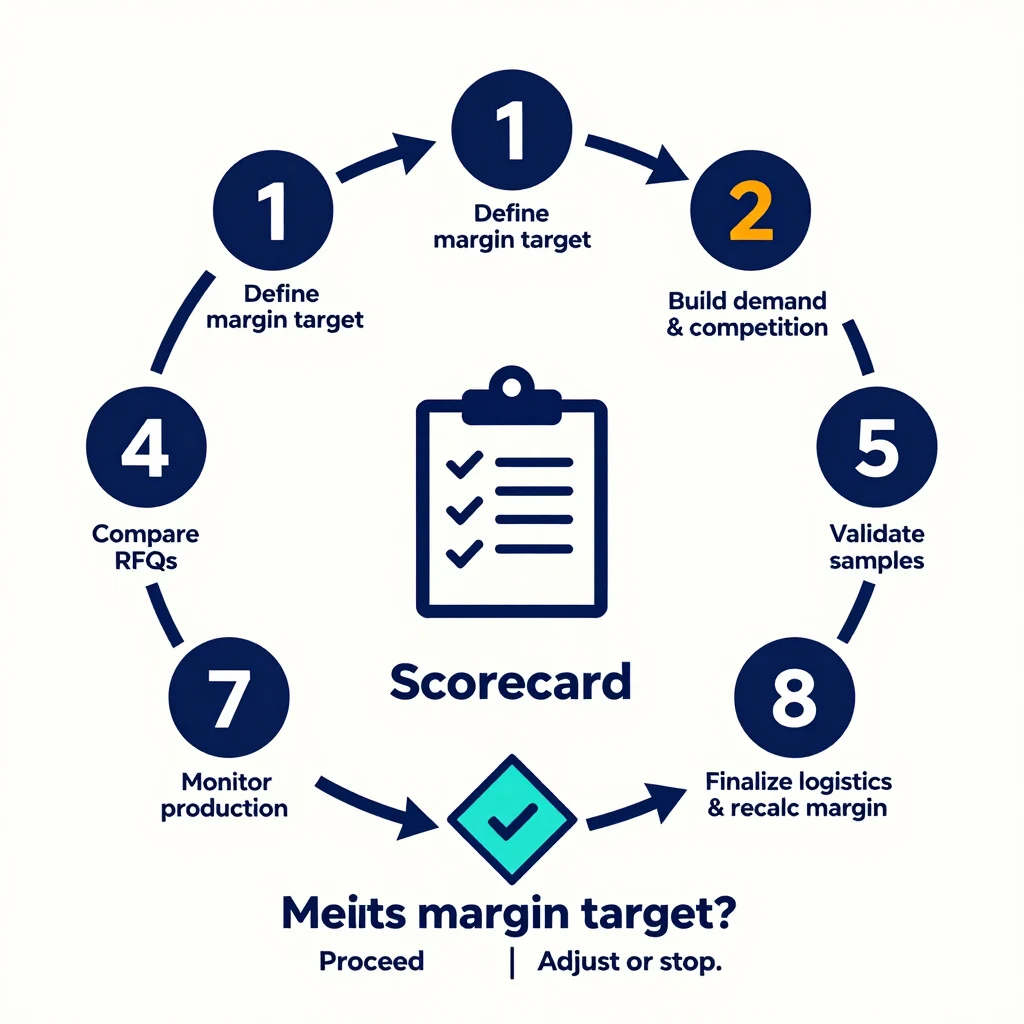
Your Product-Sourcing Scorecard
Use this scorecard to track every product you evaluate. Fill it out before you order samples, and update it as quotes and logistics figures change. If a product fails any gate, move on rather than forcing it through.
| Stage | What to Record | Gate |
|---|---|---|
| Margin target | Your minimum acceptable margin, based on your own operating costs and risk tolerance | Set before any research |
| Landed cost model | Unit cost, freight, insurance, payment fees, packaging, storage, post-purchase costs | Updated with every quote |
| Demand screen | Evidence of active customer need, scored 1–5 | Meets your threshold |
| Competition screen | Seller count, review depth, ad saturation, differentiation, scored 1–5 | Meets your threshold |
| Supplier vetting | Communication, capacity, audit results, years in operation, terms clarity | Written quote with documented MOQ |
| Sample evaluation | Dimensions, materials, function, durability, packaging, unboxing | Matches specification in writing |
| Production monitoring | Checkpoints with pass/fail criteria, issue resolution documented | No unresolved defects |
| Final margin | Recalculated with final logistics figures | Meets your target |
Decision Framework: Should You Manage Sourcing Yourself or Work With a Sourcing Partner?
Every step described above can be done by a buyer directly. The question is whether you have the time, the supplier relationships, and the tolerance for cross-border communication to do it well across multiple products.
Consider working with a sourcing partner if you have limited time, several SKUs to manage, complex specifications, or little experience with international suppliers. Consider managing it yourself if you have one product, a clear specification, and the willingness to handle quotes, samples, and follow-ups directly.
SourcingAll’s services map to each stage of this process: supplier search and vetting, sample coordination, product development, production monitoring, quality inspection, and logistics coordination. That is a decision framework, not a promise of outcomes. If you want a structured process, request a quote or contact SourcingAll to discuss your product program.
FAQ and Next Steps
How do I know if a product has enough margin potential? Build a landed-cost model and compare it with market prices. Keep your own margin target as the gate.
What makes a product low competition? Evaluate seller count, review depth, ad saturation, and differentiation. There is no universal low-competition list.
When should I use a sourcing agent instead of managing suppliers myself? Use the decision framework in the previous section.
Can SourcingAll help with supplier vetting? Yes, it provides supplier search and vetting as a service.
For more sourcing questions, see the SourcingAll FAQ page.
The process above is a checklist, not a promise. If you want help executing any step, SourcingAll offers supplier search and vetting, sample coordination, product development, production monitoring, quality inspection, and logistics coordination. Start with a get-a-quote request or contact SourcingAll to discuss your product idea. You can also browse related sourcing guides in the article hub or learn more about the company.