
Why source home goods from China?
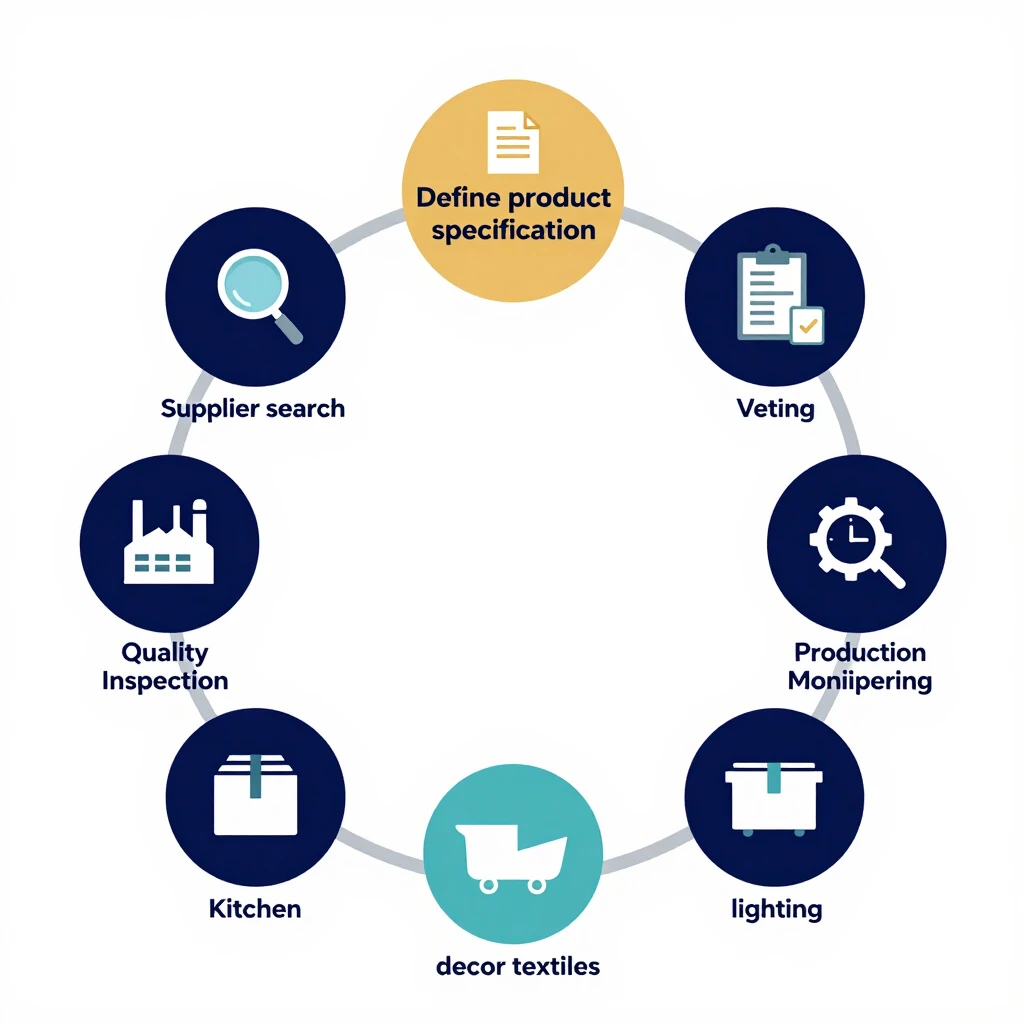
There is no single best home goods product to source from China. The right product depends on your target customer, price point, quality standard, and sales channel. What matters is how you define the specification, vet the supplier, coordinate samples, monitor production, and manage the handoff to logistics.
This is a category-level framework for small businesses, startups, ecommerce companies, and product designers. It covers the categories worth evaluating, the criteria for vetting suppliers, and the process from specification through logistics coordination. It does not include a ranked product list, because that would ignore the variables that matter in your situation.
If you are new to sourcing, the SourcingAll articles cover broader sourcing topics. Come back here when you are ready to shortlist categories and suppliers.
Which home goods categories are worth sourcing?
Home goods is a broad category. Approaching it by product family makes it easier to define the product details you need before searching. The table below lists common home goods categories and the details to define before you start.
| Category | What to define before searching |
|---|---|
| Kitchen and dining | Material, heat resistance, food-contact expectations, finish, packaging |
| Bathroom accessories | Moisture resistance, mounting method, finish, surface texture |
| Storage and organization | Dimensions, load expectations, collapsibility, material thickness |
| Home decor | Style, color, finish, assembly requirements, display packaging |
| Textiles | Fiber content, weave, weight, care expectations, dye method |
| Lighting | Voltage, bulb type, material, heat dissipation, mounting type |
These categories are starting points, not recommendations. A decorative storage basket can be a good product for one business and a poor product for another, depending on your customer base and quality bar. The same applies to kitchen tools, bathroom organizers, and textile items. Define the product family first, then narrow down to a specific product specification.
The SourcingAll article library has more on category-level sourcing decisions.
What should you check before choosing a supplier?
Before choosing a supplier, check the following.
- Supplier reliability and vetting: define what you need to verify, such as business credentials and production scope. SourcingAll’s service scope includes supplier search and vetting.
- Sample quality and coordination: coordinate samples with a written brief that covers material, workmanship, dimensions, finish, and packaging. Keep a record of what was requested and what was approved.
- Product development support: if you plan to customize an existing product or develop a new one, confirm that the supplier can handle changes to materials, dimensions, colors, and packaging. Product development is part of SourcingAll’s service scope.
- Production monitoring and quality inspection: clarify how production progress and finished goods will be reviewed. SourcingAll’s service scope includes production monitoring and quality inspection.
- Logistics coordination: clarify who prepares the packing list, coordinates the shipment, and handles the handoff to your freight forwarder. SourcingAll’s service scope includes logistics coordination.
These criteria align with the services offered by SourcingAll, which covers supplier search and vetting, sample coordination, product development, production monitoring, quality inspection, and logistics coordination for international buyers.
How does the sourcing process work from search to logistics?
The sourcing process for home goods can be organized into the following steps.
- Supplier search: build a shortlist of potential suppliers based on the product specification. SourcingAll’s service scope includes supplier search.
- Supplier vetting: review supplier information against your requirements. SourcingAll’s service scope includes supplier vetting.
- Sample coordination: request samples using a written sample brief. Evaluate the sample against the brief and record your approval or requested changes.
- Product development: if product changes are needed, work with the supplier on revisions and use the approved sample as the reference for production.
- Production monitoring: track production progress against the timeline and agreed milestones. SourcingAll’s service scope includes production monitoring.
- Quality inspection: arrange a quality inspection before shipment. SourcingAll’s service scope includes quality inspection.
- Logistics coordination: prepare the packing list and confirm the shipment handoff to your freight forwarder. SourcingAll’s service scope includes logistics coordination.
The how SourcingAll works page explains the workflow in detail.
Hypothetical example: sourcing a decorative storage basket
This example is hypothetical. It does not describe any actual client project or supplier relationship. It shows how the sourcing process works in practice.
Imagine a small ecommerce business wants to source a decorative storage basket with a natural fiber look and a collapsible design. The owner defines the product specification: a specific height and diameter, a maximum weight when filled, a color range, and a packaging requirement for flat shipping.
The process would look like this:
- Search for suppliers that make woven or fiber storage baskets and shortlist three candidates.
- Vet each supplier by checking their business credentials, production scope, and references.
- Request samples from two suppliers using the same sample brief. Compare material feel, dimensions, stitching or weave quality, and packaging.
- Approve one sample and request a small change to the rim finish.
- Confirm the revised sample, then place a trial order.
- Monitor production and arrange an inspection before shipment.
- Review the inspection results, approve the shipment, and coordinate logistics with a freight forwarder.
The point is to define the specification, check the sample, and review the finished goods before approving shipment.
What are the most common sourcing pitfalls?
Review your sourcing plan for these gaps.
- Skipping supplier vetting. Without vetting, you have less information about whether a supplier fits your product requirements.
- Neglecting sample coordination. Without a written sample brief, a supplier may not know what you expect, and the sample may need to be repeated.
- Overlooking production monitoring. Waiting until production is complete gives less time to address issues before shipment.
- Ignoring inspection findings. If you arrange a quality inspection, use the results to decide whether the goods need correction before shipment.
- Leaving logistics unclear. If no one owns the packing list, shipment booking, and delivery handoff, the handoff after production becomes harder to manage.
The SourcingAll FAQs answer common sourcing questions and objections.
How can SourcingAll support your home goods project?
SourcingAll provides sourcing services for international buyers. The service covers supplier search and vetting, sample coordination, product development, production monitoring, quality inspection, and logistics coordination.
For a home goods project, that coverage spans the main stages from supplier search through logistics coordination.
Review the full range of services on the SourcingAll services page. The about page explains the company background, and the case studies show how sourcing projects are presented.
When you are ready to discuss your home goods project, contact SourcingAll or request a quote.
Sourcing checklist for home goods
Use this checklist before you commit to a supplier or place an order.
- Define the product family and the specific product specification.
- Write a sample brief with dimensions, materials, colors, finish, and packaging.
- Shortlist at least three suppliers and vet each one.
- Request samples and evaluate them against the brief.
- Confirm the approved sample before production.
- Schedule production monitoring and agree on progress updates.
- Arrange an inspection before shipment.
- Review the inspection results and decide on any corrections.
- Confirm the packing list and logistics handoff.
The checklist does not replace a detailed sourcing agreement. It is a practical reminder of the steps you may want to include in your sourcing plan.
Define the product specification first
The right product for your business is one you can specify clearly, vet a supplier for, and verify through samples and inspection. Start with the product family, then write the specification. If you need help with supplier search, vetting, sample coordination, production monitoring, quality inspection, or logistics coordination, SourcingAll offers services that cover the full process. You can start by requesting a quote.