
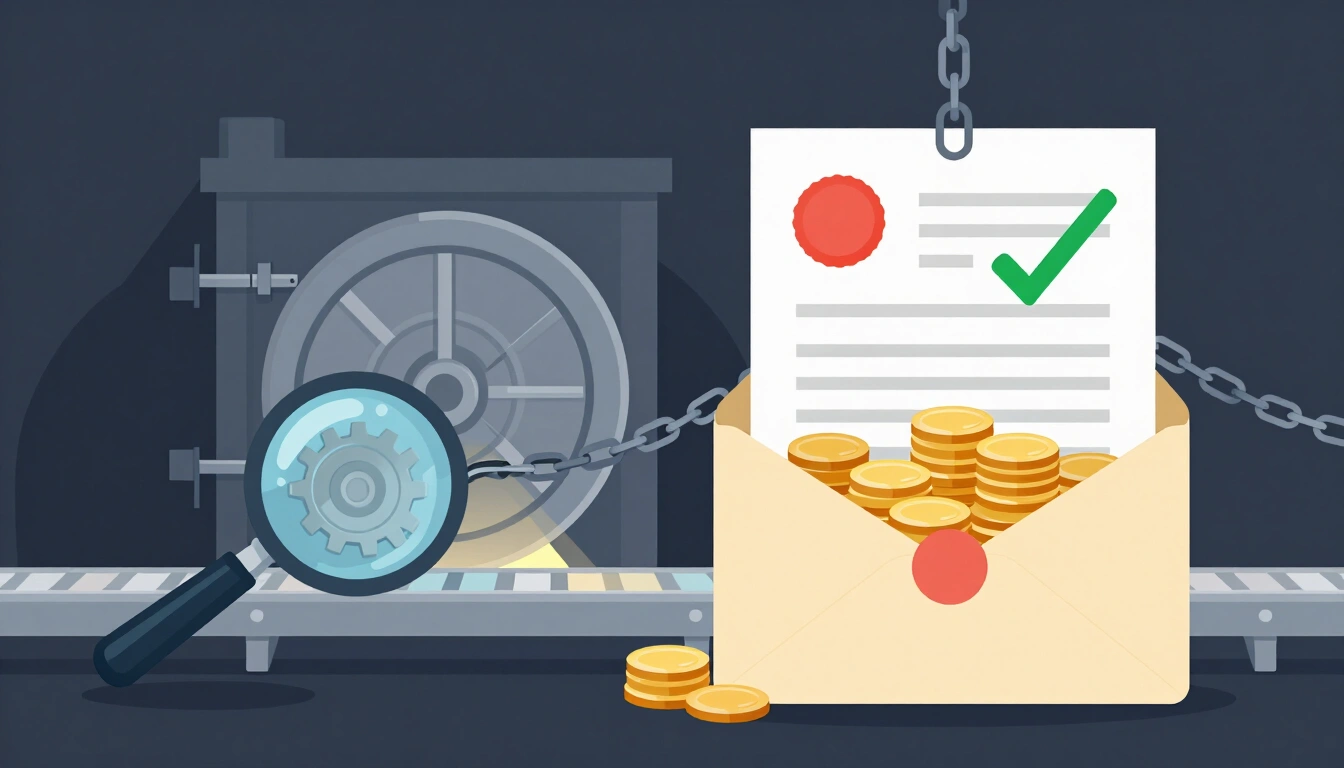
You have compared quotes from several factories. The standout quote sits well below the rest, its representative answers at any hour, and the workshop photos look almost too clean. Then the message arrives: “Deposit needed to start production.” You have not signed a contract. You have not approved a sample that came off the real production line. And you have never seen the bank account the money is about to enter. Up to this point, the factory has been selling you a story. After the wire is sent, the factory’s incentives change.
Vetting is not a dramatic inspection event. It is a sequence of checks that starts cheap and gets deeper only when the risk justifies the cost. Work through the list in the order that follows, because the cheap checks are the ones that stop a bad deal before it starts.
1. Start with the company, not the website
A factory is a legal entity before it is anything else. The document to ask for is the business license, and the opening check is an identity check: the legal name on the license must match the name on the contract and the name on the bank account receiving the wire. If those names differ, stop. You are not paying the company you think you are paying.
A business license is a snapshot, and snapshots go stale. Even in a straightforward jurisdiction, a license may no longer be valid the moment any detail on it changes. The City of Elk Grove, for example, requires a new application when any information on a license changes. The general lesson applies to any supplier: you need the current registry record, not a photocopy someone sent you last season. If the registration record is in Chinese, have a native reader compare the registered name against your contract line by line. An English translation that looks close is not the same as a match in the registry.
Here is a scenario that plays out more often than it should: a buyer wires a deposit to what looks like the factory’s account, and the money actually lands in the personal account of a sales agent who was never employed by the factory. The license-versus-account-name check stops that before the wire.
2. Read the factory’s own claims as raw material, not proof
Look at what the factory says about itself. A custom challenge coin maker’s homepage may advertise free design, free shipping, and a standing discount. None of that tells you whether tolerances hold on the production line, whether the factory has room for your order, or whether it will still be in business when the goods are ready.
A website cannot show how many orders are ahead of yours, whether the machines are owned or leased, how many quality inspectors work the floor, or whether the sales rep is an employee of the factory or an independent agent. Write those questions down before the call. A factory that answers with machine counts and delivery dates is giving you evidence. A factory that answers with promises is giving you marketing.
3. Run the sample loop before you talk about deposits
The sample is the cheapest failure you will ever buy, provided you use it correctly. Ask for a sample from the actual production line, not the sample shop. A dedicated sample room can produce a perfect-looking unit; a production line has to reproduce the same result at volume. If the factory can only make your product in the sample room, that is the capability you will be betting on.
Then write down everything you approve: materials, dimensions, color, packaging, markings, assembly details. Send the list back and call it the approved specification. Keep the sample itself in a safe place, because every later inspection should be measured against it. If the factory asks what the reference is, you have left the door open for argument.
Weigh the cost honestly. Samples cost money and time, and on a commodity item with thin margins a full pre-production sample can feel like a luxury. That tradeoff can be reasonable, but make it deliberately. A container of product that does not match what you approved is far more expensive than any sample.
Expect to pay for the sample and for shipping; that is normal. A factory that will not ship a sample without a production deposit is telling you where its priorities sit.
4. Ask what the factory can prove about how it treats workers
Labor records belong in a vetting file whether or not your product is labor-intensive. In the US, employees’ right to organize is protected, and threats of job loss tied to union support are unlawful; the National Labor Relations Board’s own guidance lists that kind of conduct as a violation. If the factory operates facilities in the US, that obligation applies directly. For production in China, the conversation will not sound the same, but the question is still worth asking: what labor audits or certifications exist, and what happened the last time a worker raised a complaint?
Do not read this as a moral scorecard. View it as a delivery risk. Labor disputes shut down lines, and shutdowns destroy delivery dates. A factory with an unresolved complaint history is a factory whose schedule you should price risk on. A factory that has never thought about a labor audit is not necessarily hiding anything; a factory that gets angry at the question is.
5. Structure payment so the factory keeps proving itself
Deposits are not the problem. In Chinese manufacturing, a deposit is normal because it buys materials, and materials are not free. The problem is a deposit with no evidence attached. Before you agree to a deposit, agree to what it specifically covers: raw materials, tooling, a production slot, or some combination of those. Then agree to what you will receive in exchange and when you will receive it.
Build the rest of the payment schedule around the same logic. A portion releases when the factory sends production photos or welcomes an in-process inspection. A portion releases against a pre-shipment inspection. The final portion releases against the bill of lading. Each release is a checkpoint where the factory has to show something before you pay.
Never wire to a personal account. The payee must be the legal entity named on the license. If the bank account name and the license name do not match, the payment is the end of the negotiation, not the beginning.
Here is the honest tradeoff. Very small factories live hand to mouth. They cannot buy materials without your deposit, and a buyer who refuses every deposit will miss real capacity and real prices. The answer is not to avoid deposits; it is to make the deposit proportional, tied to materials, and documented. The less you have verified about a factory, the more the payment schedule should tilt toward the back end.
6. Match verification depth to the risk
Verification comes in different depths. A live video walk-through confirms the operation exists; it costs little and is worth doing at the start. An independent pre-shipment inspection costs more and tells you whether the goods actually meet the approved specification. A full audit, covering management systems, financial health, equipment condition, and labor records, costs the most and earns its cost when the order is large or the product carries legal exposure.
The question is not whether to audit, but how much a failure would cost. For an order that is small and low-risk, a video call plus a pre-shipment inspection may be proportionate. For an order that is large, regulated, or sold under your own warranty, a lighter check is false economy.
The scorecard below is the working file. Keep it open next to the quote and fill it in before approving any payment. If a row ends red, resolve it before money moves.
| What to verify | How to verify it | What should stop you |
|---|---|---|
| Legal registration | Current business license and registry record; compare the legal name with the contract | License expired, or the name on the license does not match the contract |
| Bank details | Compare the payee name on the wire instructions with the legal entity named on the license | Personal account, or a payee name that differs from the license |
| Production capability | Video walk-through of the actual floor; ask about machine counts and order backlog | Refusal to show the floor, or footage that looks like a different facility |
| Sample traceability | Sample from the real production line; approve a written spec list | Sample only available from the sample room, or no spec list |
| Labor and compliance | Ask about labor audits, certifications, and complaint history | Evasive answers, or an unresolved dispute that can halt production |
| Payment milestones | Tie the deposit to materials; release later payments against inspection reports | Deposit before any evidence, or a payment schedule with no documentation points |
Vetting does not guarantee a good shipment. A factory can pass every check and still deliver late or off-spec, which is why the payment schedule matters as much as the documents. But these checks are the ones that separate a real factory from a convincing impersonation, and they all happen while you still hold the money.
The factory that answers with evidence is the one you can reasonably pay. The factory that asks for trust is asking you to carry risk it will not share. If you would rather have someone else do the walking and checking, SourcingAll’s process includes factory visits and verification before production and a final inspection before shipment. Either way, start with the license and work through the list while the leverage is still on your side.