
You’re staring at a supplier quote from a factory in Shenzhen for a shipment of kitchen scales. The unit price looks attractive, but you have been burned before by costs that weren’t on the quotation. The real question is what the total landed cost will actually be, and that depends on decisions you haven’t made yet: how you ship, how you classify the product, and what fees attach at the border.
Let’s walk through the costs that turn a supplier invoice into a cleared, delivered shipment.
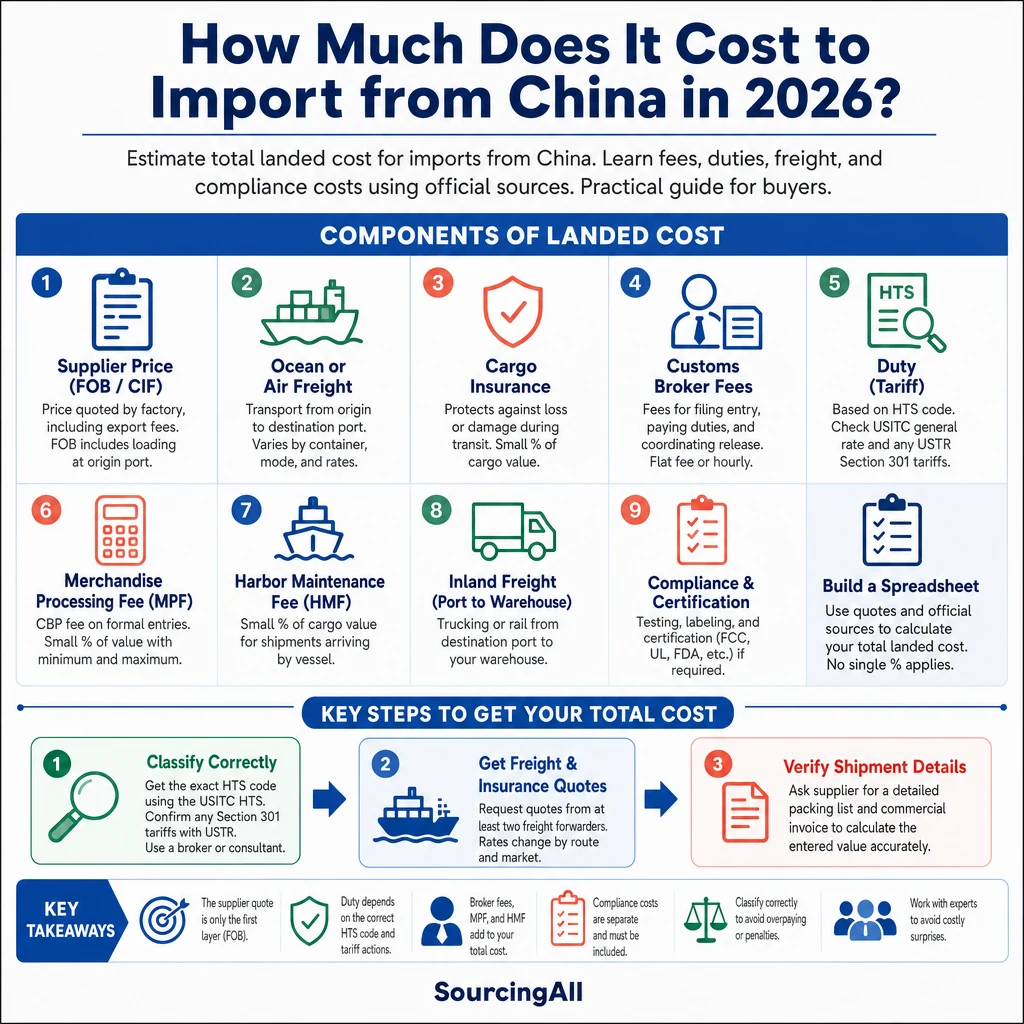
The Supplier Quote Is Only the First Layer
The unit price you see is the FOB (Free on Board) price. That means the factory is responsible for getting the goods to the port in China and loading them onto the vessel. Everything after that – ocean freight, insurance, customs clearance in the U.S., duty, inland freight from the destination port to your warehouse – is your cost.
The exact numbers for freight and insurance depend on container type (20-foot or 40-foot), origin port, destination port, current shipping rates, and whether you use a freight forwarder or handle it yourself. Insurance typically runs a small percentage of the cargo value, but the rate varies by carrier and coverage level. No one can give you a universal figure because rates change weekly and differ by route.
Determining the Duty Rate: Where the USITC HTS and USTR Come In
The single biggest variable after freight is the duty you pay when goods enter the United States. That rate is not fixed for ‘kitchen scales’ – it depends on the specific Harmonized Tariff Schedule (HTS) classification you assign to the product.
The U.S. International Trade Commission publishes the current HTS at https://hts.usitc.gov/. You need to search that database for the heading that matches your product. The correct 10-digit subheading must be identified because even a one-digit difference can change the duty rate from zero to several percent. A customs broker can help assign the accurate code.
Once you find the correct subheading, the USITC site shows the ‘General’ duty rate – the rate that applies to imports from countries with Normal Trade Relations (which includes China). For many weighing machines, the general rate is zero percent. But not all subheadings have zero – some have rates of a few percent. And that’s before any additional tariffs that may apply under Section 301 (the China tariff lists). Many Chinese goods may be subject to additional Section 301 duties, depending on the product’s HTS code and current tariff actions. You must check the current USTR tariff actions page for product-specific entries.
Because tariffs change, you cannot assume any specific percentage. You must look up the current HTS code and then check the U.S. Customs and Border Protection website for any active Section 301 annexes. CBP’s ‘Basic Importing and Exporting’ page at https://www.cbp.gov/trade/basic-import-export/importer-exporter-tips gives an overview of importer responsibilities, including the need to determine classification and duty rate. Additionally, the U.S. Trade Representative publishes Section 301 tariff actions at https://ustr.gov/issue-areas/enforcement/section-301-investigations/tariff-actions.
Customs Brokerage and Other Fees
When your shipment arrives at a U.S. port, you need a customs broker to file the entry documentation and handle the clearance process. Brokerage fees can range from a flat fee for a simple entry to several hundred dollars for more complex transactions involving multiple parts or regulatory oversight. These fees are not fixed by law – they are negotiated between you and your broker.
In addition, U.S. Customs and Border Protection collects two fees on most formal entries: the Merchandise Processing Fee (MPF) and, for ocean shipments, the Harbor Maintenance Fee (HMF). Both are calculated as small percentages of the entered value with minimum and maximum amounts set by regulation. Your broker will include these in the total cost estimate.
If your product requires special testing, labeling, or certification (e.g., FCC for electronics, FDA for food-contact surfaces, UL for safety), there are separate compliance costs. For kitchen scales, if they have a battery or wireless connectivity, you may need FCC certification. If they will contact food, you need FDA registration and possibly material testing. Those costs are independent of the import process itself but are real costs that must be factored into your total landed cost.
Estimating the Duty and Total Cost Without Specific Numbers
To estimate your duty, you start with the supplier’s invoice value (FOB or CIF). That value is the basis for calculating duty, though U.S. Customs uses the transaction value, which is typically the price actually paid for the goods. Once you have the correct HTS code and know the general rate and any Section 301 additions, you apply the total duty percentage to the entered value. The result is your estimated duty.
After duty, add freight, insurance, broker fees, MPF, HMF, and inland transportation. The sum of all these components is your total landed cost. The only way to get a reliable estimate is to request quotes from a freight forwarder and a customs broker, and to confirm the HTS classification with a professional.
For example, suppose your supplier quote is for a container of kitchen scales. The freight forwarder provides a current rate for ocean freight from Shenzhen to Los Angeles. Insurance is a small add-on. The broker quotes a fee for entry filing and handling. After looking up the HTS code and checking Section 301, you find that the total duty rate is a certain percentage. By plugging in the actual numbers, you get a total that may be significantly higher than the initial FOB price. The exact figures depend on the specific shipment and current market conditions.
The Table: Components of Landed Cost (No Numbers)
Here is a table you can use to estimate your own landed cost. Fill in the amounts based on actual quotes.
| Componente de costo | Descripción | How to Estimate |
|---|---|---|
| Supplier Price (FOB / CIF) | Price quoted by factory, including any export fees. FOB means cost includes loading at origin port. | From supplier quotation |
| Ocean or Air Freight | Cost to transport goods from origin to destination port. Varies by container size, shipping mode, and current market rates. | Get quote from freight forwarder |
| Cargo Insurance | Protects against loss or damage during transit. Typically a small percentage of cargo value. | Ask freight forwarder for rate |
| Customs Broker Fees | Fees for filing entry, paying duties, and coordinating release. Flat fee per entry or hourly. | Get quote from broker |
| Duty (Tariff) | Calculated by applying the HTS classification duty rate to the entered value. Check USITC HTS for general rate and any applicable additional tariffs from USTR. | Use USITC HTS, USTR tariff actions, and broker |
| Merchandise Processing Fee (MPF) | A fee collected by CBP on formal entries. Small percentage of entered value with minimum and maximum. | Calculate based on entered value using current CBP fee schedule |
| Harbor Maintenance Fee (HMF) | Small percentage of cargo value for shipments arriving by vessel. | Apply to ocean shipments only |
| Inland Freight (Port to Warehouse) | Trucking or rail from destination port to your warehouse or final delivery point. | Get quote from domestic carrier |
| Compliance & Certification | Costs for testing, labeling, certification (FCC, UL, FDA, etc.) if required for your product. | Varies by product category – get quotes from testing labs |
Use this table to build a spreadsheet. Do not rely on a single percentage or fee estimate from an article – get real quotes for freight, insurance, and brokerage. The only way to know your exact cost is to run your actual shipment through a full estimate.
Why You Must Classify Correctly
If you classify your product incorrectly, you risk two outcomes: overpaying duty (if you choose a higher-rated heading) or underpaying and facing penalties. CBP has the authority to re-classify goods during entry review and can assess additional duties plus late-payment interest. If they find you intentionally misclassified, penalties can be severe.
The USITC HTS is the official source for general rates, and USTR provides current Section 301 additions. You can also request a binding ruling from CBP for a specific product, but that takes time. Most importers rely on their customs broker or a consultant to assign the correct HTS code. This is not a place to guess.
SourcingAll Can Help You Avoid Costly Surprises
At SourcingAll, we work with buyers to coordinate not just the supplier side, but also logistics and compliance. If you are evaluating a supplier quote and need to understand the full landed cost, we can help you identify the right HTS classification, recommend freight options, and connect you with trusted customs brokers. We do not set duty rates or freight prices – those are market-driven – but we can guide you through the process so that you have a realistic budget before you place an order.
To get started, request a free quote at https://sourcingall.com/get-a-quote/. Tell us what you are importing, and we will help you map out the cost components that matter most for your product.
Your Next Decision
You now have a framework to compare supplier quotes against total landed cost. The next step is not to search for a universal ‘cost to import from China’ number – that doesn’t exist. Instead, take these three actions:
- Get the exact HTS code for your product from a customs broker or using the USITC HTS.
- Request freight and insurance quotes from at least two freight forwarders.
- Ask your supplier to provide a detailed packing list and commercial invoice so that you can calculate the entered value accurately.
Once you have those figures, you can decide whether the business model works at the final landed cost.