
Finding a Chinese manufacturer online is not the hard part. Deciding which supplier candidates have enough product-specific evidence to move forward is harder.
When visiting China is not feasible, remote sourcing requires a deliberate process. A polished supplier profile, quick reply, business document, video call, or satisfactory sample can each be useful inputs. None of these items alone establishes legal identity, manufacturing capability, bulk-production consistency, or product compliance.
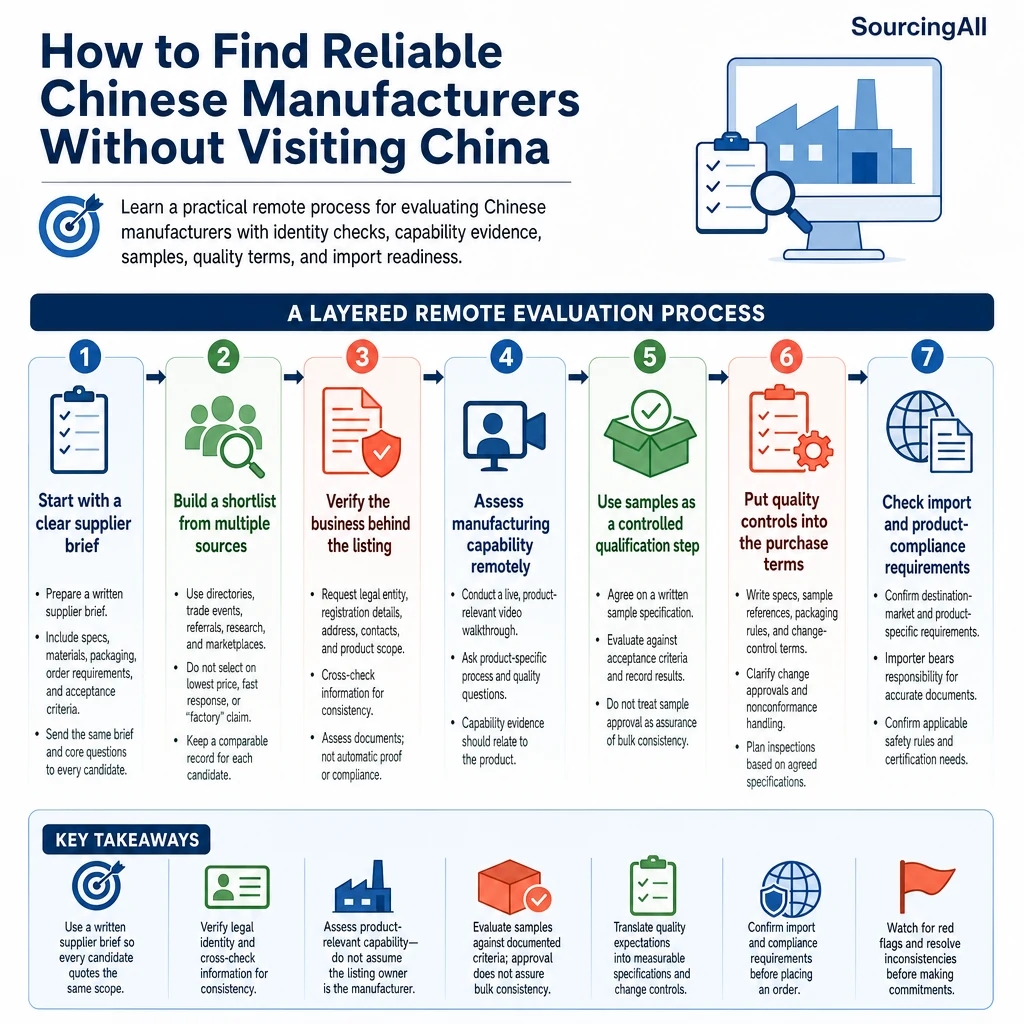
A stronger approach is to gather evidence in layers and compare it with a written product brief. Material inconsistencies should be resolved before making commitments. The level of verification should reflect the product’s complexity, the consequences of failure, the commercial exposure involved, and destination-market requirements.
1. Start with a clear supplier brief
Remote evaluation becomes difficult when each supplier receives a different description of the product. Before searching, prepare a written supplier brief that gives every candidate the same scope to assess.
Include the product specification, materials, dimensions, intended function, finish expectations, packaging requirements, order requirements, and quality acceptance criteria. If a feature is essential, define it rather than relying on broad language such as “good quality.” Document cosmetic expectations, functional checks, permitted variations, and any drawing or reference sample intended to guide production.
Identify questions that need separate confirmation for the destination market. Import documentation, labeling, testing, certification, and safety obligations may depend on both the product category and the market where the item will be sold. A supplier’s general statement about compliance should not replace product-specific confirmation.
Send the same brief and core questions to every candidate. This makes quotations, technical responses, proposed materials, packaging assumptions, and production arrangements easier to compare. If one quotation is based on different materials, specifications, packaging, or scope, identify those differences before treating the quotations as comparable.
2. Build a shortlist from multiple sources
Manufacturer directories, trade-event exhibitor information, referrals, product-category research, and online marketplaces can help identify potential suppliers. These are discovery channels rather than final verification methods.
Do not select a candidate solely because it has the lowest quotation, a polished storefront, a fast response, or a description of itself as a factory. Listings may be maintained by manufacturers, trading companies, or businesses that use subcontractors. That distinction is not automatically disqualifying, but it affects the questions to ask and the evidence to request.
Create a comparable record for every shortlisted candidate. Record the legal entity name provided, contact details, claimed product scope, stated production role, requested documents, technical responses, sample status, and unresolved questions. A written comparison helps make inconsistencies visible instead of leaving them spread across messages and files.
3. Verify the business behind the listing
Ask each serious candidate for its legal entity name, business registration details, operating address, primary contact information, product catalog, and documents it considers relevant to the quoted product. Request a direct explanation of whether it manufactures the product, trades it, or relies on subcontractors for any part of the work.
Then cross-check the information received. Names, addresses, scope statements, contact details, bank details, and explanations of the production arrangement should remain consistent across documents and communications. A mismatch does not establish wrongdoing by itself, but it is a reason to pause and seek clarification before progressing.
Supplier-provided licenses, certificates, factory photographs, audit reports, and test reports are documents to assess rather than automatic proof. If a supplier provides quality-management documentation referring to ISO 9001:2015, review its scope and relevance to the operation involved. ISO 9001:2015 is a quality-management-system standard; it does not by itself establish product compliance, capability for a particular item, or supplier reliability.
The International Trade Administration’s China market-entry guidance notes the importance of due diligence and understanding local regulations. For remote sourcing, this supports a process that combines documentary review, product-specific questions, and clear commercial terms.
4. Assess manufacturing capability remotely
A live video walkthrough can be useful when it is planned around the quoted product. Ask the supplier to show relevant production steps, equipment, incoming materials, work in progress, finished goods, packaging activity, and the people responsible for technical or quality questions. Generic facility footage has limited value when it cannot be connected to the product you plan to buy.
Prepare product-specific questions in advance. Ask how a key material is identified, how a critical dimension is checked, where packaging is completed, what happens when an item does not meet an agreed requirement, and whether any operation is outsourced. Compare the answers with the written quotation, drawings, sample, and earlier communications.
Capability evidence should relate to the product, not simply show that a business occupies a facility. A supplier may have equipment on site while another party performs material processing, component production, finishing, or final assembly. Clear disclosure gives you a better basis for planning controls than unsupported assumptions.
| Escenario | Remote action | Evidence to collect | Decision rule |
|---|---|---|---|
| Supplier brief | Send identical written specifications and questions to each candidate. | Product specification, packaging requirements, order requirements, and quality acceptance criteria. | Do not compare quotations until scope differences are identified. |
| Business identity | Request the legal entity, registration details, address, contacts, and product scope. | Supplier-provided registration and contact records. | Investigate inconsistencies before moving forward. |
| Capability | Conduct a live, product-relevant video walkthrough and technical discussion. | Process explanation, relevant equipment evidence, production-flow information, and subcontracting disclosures. | Do not assume the listing owner is the manufacturer. |
| Sample | Evaluate a sample against written acceptance criteria. | Approved sample record, evaluation notes, and change log. | Do not treat sample approval as assurance of bulk consistency. |
| Quality planning | Write inspection points, tolerances, packaging rules, and change-control terms into purchase documentation. | Signed specifications, approved sample reference, and inspection checklist. | Resolve ambiguous requirements before production begins. |
| Compliance and import readiness | Confirm destination-market and product-specific requirements with the relevant authority or a qualified adviser. | Applicable compliance documentation and import records. | Do not rely solely on supplier assurances for regulated products. |
| Pre-envío | Use an appropriate final check before release when product and order risk justify it. | Inspection report, defect findings, packing evidence, and shipment documentation. | Address documented nonconformities before shipment where contract terms permit. |
5. Use samples as a controlled qualification step
A sample is useful because it makes the requirement tangible. It can show whether the supplier’s interpretation of materials, construction, appearance, function, and packaging matches your expectations. A good sample, however, is evidence about that sample. It does not assure that later production will match without documented controls.
Before sample production, agree on a written sample specification. Evaluate the result against documented acceptance criteria rather than memory or informal impressions. Record what was accepted, what was rejected, and any changes that are required. If an accepted sample becomes the production reference, identify it clearly in purchase documentation and retain a record of the approved version.
Where the product warrants it, arrange appropriate testing or specialist review based on the item and destination market. Do not rely only on a supplier statement that a sample or finished product meets an unspecified requirement.
6. Put quality controls into the purchase terms
Quality expectations need to be actionable during production and inspectable before shipment. Translate the supplier brief into measurable specifications, approved sample references, packaging instructions, inspection criteria, and change-control expectations. Clarify which changes require written approval, including changes to materials, manufacturing location, subcontracting arrangements, packaging, or product construction.
Purchase documentation should also address how nonconformities are documented and handled, subject to the agreement between the parties. Ambiguous descriptions can lead to conflicting interpretations after production has started. Clear documentation does not guarantee performance, but it provides a more useful basis for monitoring and resolving issues.
Production-stage updates and an independent inspection plan can be considered when the product and order risk justify them. The inspection scope should be tied to agreed specifications rather than a vague request to check quality.
7. Check import and product-compliance requirements before ordering
Supplier evaluation and import readiness are connected, but they are not the same task. Requirements vary by destination market and product category. Before placing an order, confirm the importer responsibilities, documentation, origin marking, packaging, labeling, and any product-specific obligations applicable to the destination.
For imports into the United States, U.S. Customs and Border Protection states that importers are responsible for exercising reasonable care and providing accurate import documentation, packaging, and origin labeling. Its guidance is available in Importing into the United States.
Some consumer products may be subject to applicable safety rules and certification requirements. The U.S. Consumer Product Safety Commission explains that a General Certificate of Conformity may be required for consumer products subject to applicable CPSC safety rules. For children’s products subject to applicable safety rules, the agency provides separate guidance on the Children’s Product Certificate. These references do not determine requirements for an unspecified item; confirm the rules that apply to the actual product and destination market.
8. Recognize remote-sourcing red flags
Remote sourcing involves uncertainty. Not every unanswered question signals a problem, though you should stop and investigate when important information remains inconsistent or undocumented.
- Legal names, addresses, contacts, or bank details change without a clear explanation.
- The supplier will not provide product-relevant documents or answer technical questions directly.
- A candidate pressures you to pay before specifications, acceptance criteria, and production arrangements are agreed.
- The factory, material, product scope, or subcontracting arrangement changes after earlier representations.
- Requested video evidence remains generic and does not show the quoted product’s relevant process.
Each point calls for further verification rather than an unsupported conclusion. Keep a written record, ask for clarification, and compare each response against the evidence you have collected.
9. Use a layered verification process
A useful remote process is sequential: shortlist candidates, verify identity, assess product-relevant capability, approve a controlled sample, document production requirements, monitor where appropriate, and complete pre-shipment checks when justified. Each stage addresses a different uncertainty.
This structure also helps when a supplier appears promising but the evidence remains incomplete. Instead of asking whether a business is “reliable” in the abstract, ask narrower questions. Is the legal identity consistent? Is the production role disclosed? Does the supplier understand the specification? Does the sample meet documented criteria? Are quality and change-control terms included in the purchase documents? Have destination-market requirements been confirmed?
Buyers seeking support with supplier identification, quality control, and logistics coordination can review SourcingAll’s sourcing process as an optional starting point.