
The moment before you wire a deposit to a supplier in China is the moment most beginner importers learn the hard way. This is a practical guide that walks you through seven common mistakes and how to avoid them, with a focus on a realistic bulk order scenario while keeping you aligned with responsible sourcing practices and verifiable standards.
Step 1: Skipping Supplier Verification
The gold star badge on a platform does not prove factory status or production capacity, and it does not guarantee that a business license is valid. A supplier may present themselves as a factory even when they are a trading company, and trading companies can still deliver acceptable products—but you need to know who you are actually dealing with because that affects pricing, communication pace, and your ability to resolve issues if something goes wrong.
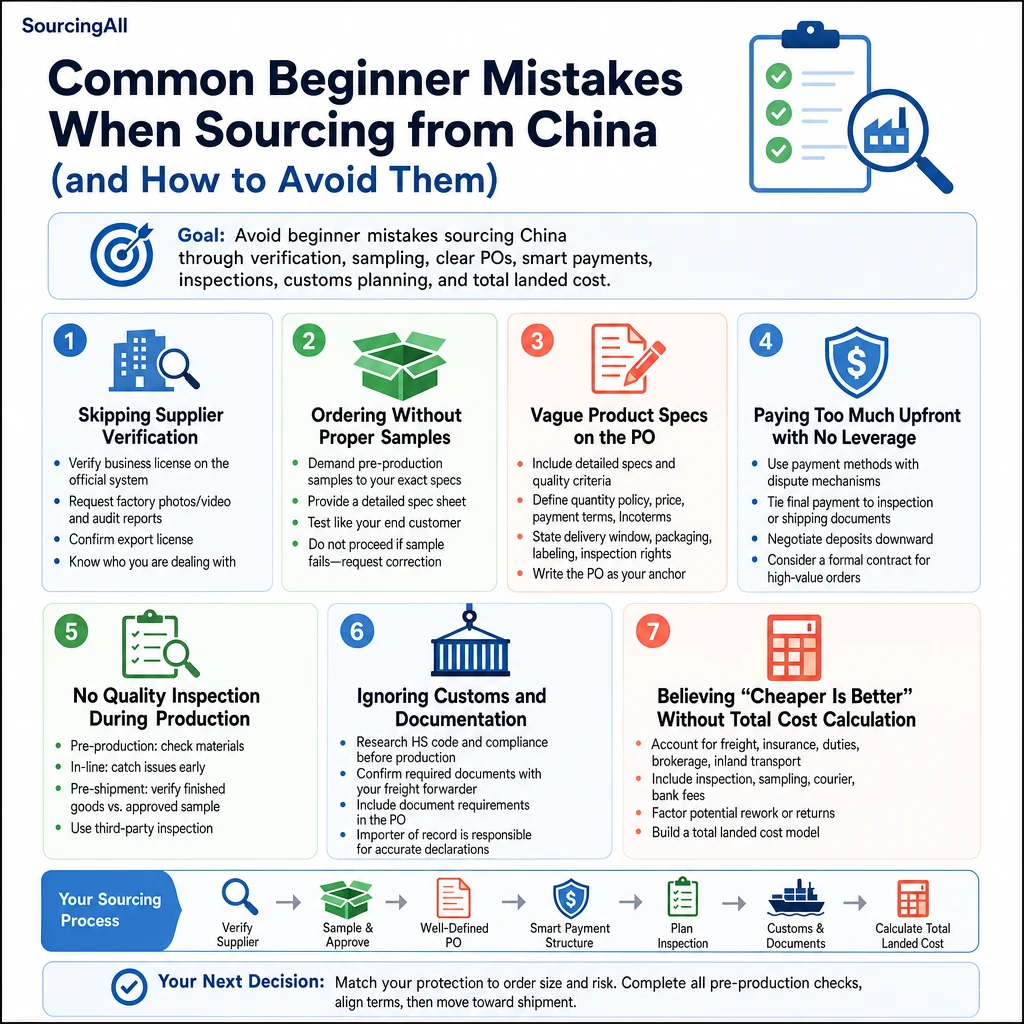
Before you discuss price, ask for and verify a set of concrete credentials. Here is what to request and how to interpret it:
| Document or Check | What it tells you | What beginners often accept instead |
|---|---|---|
| Business license (营业执照) | Legal registration, company name, registered capital, business scope | A screenshot of a passport or a random business card |
| Factory exterior and production line photos or video call | Physical location, equipment, actual working conditions | Clean showroom photos with product displays |
| Third-party audit report (e.g., BSCI, ISO 9001) | Working conditions, quality management system capability | Supplier claiming “we have ISO” without showing a certificate |
| Licencia de exportación | Legal authority to export certain product categories | Supplier saying “we can arrange export through our forwarder” |
You can verify a Chinese supplier’s business license through the National Enterprise Credit Information Publicity System, which is the official business registry operated by the State Administration for Market Regulation. This is a free, publicly accessible database. A commercial service is not official. Take a concrete step: ask the supplier to send you their business license number and cross-reference the company name and registration number on the official system. If the registration number does not match the company name, you have a red flag before you even talk about samples. For readers curious about how vetting is approached in practice, see the internal page linked here.
Step 2: Ordering Without Proper Samples
New buyers often skip samples or opt for the so‑called free sample from a listing. A free or stock sample was produced under unknown conditions and months ago; it does not reveal the conditions under which your bulk order will be produced. Demand a pre-production sample made to your exact specifications. Provide a product specification sheet—not a screenshot of a competitor’s listing. Your spec sheet should cover:
- Dimensions with tolerances
- Material composition with percentages
- Color codes (Pantone numbers, not vague color names)
- Peso
- Packaging requirements
- Functionality test conditions
When the pre-production sample arrives, test it the way your end customer would use it. If it is a mug, test with hot liquids; if it is a phone accessory, test fit and repeated use; if it is a garment, assess wash behavior and fit. A supplier who hesitates to produce a pre-production sample or who asks for payment before producing one is not necessarily a bad partner, but a supplier who will not adjust the sample after your feedback is a red flag.
Your decision point: if the pre-production sample fails critical tests, do not place the bulk order. Request a corrected sample, and if the supplier cannot correct it after reasonable feedback, consider moving on to another supplier.
Step 3: Vague Product Specifications on the Purchase Order
As you move from sample to bulk production, the purchase order becomes your legal and operational anchor. A PO that simply says “ceramic mug, 11 oz, white” is not enough. A robust PO includes:
- Product name and SKU
- Detailed specifications matching the approved sample
- Quantity with an agreed overrun or underrun policy
- Unit price and total value
- Payment terms (deposit percentage, balance upon what condition)
- Incoterms (FOB, CIF, etc.) and a clear transfer of risk
- Delivery window (a range rather than a single date)
- Packaging specifications
- Labeling and marking requirements
- Quality acceptance criteria and inspection rights
Beginners often draft a minimal PO and rely on messaging to fill gaps. When the shipment arrives with the wrong branding or packaging, the supplier may point back to the PO as the sole controlling document. Write the PO as though you will need to enforce it in a dispute because you might.
Step 4: Paying Too Much Upfront with No Leverage
Traditional supplier relationships often involve a deposit with the balance due before shipment. The risk is that once funds are transferred, leverage to push for corrective action diminishes. Your options include using a structured payment method that provides a formal path for complaints, or negotiating terms that preserve leverage while keeping cash flow workable.
Consider payment structures that include formal dispute mechanisms or bank instruments when appropriate, and negotiate deposits downward when possible. Tie final payment to a verification step such as an inspection report confirming conformity to the approved sample. A supplier who refuses this condition may have reasons to fear defect disclosure or delays.
In practice, some buyers propose a compromise: partial payment after inspection and the remainder upon receipt of shipping documents. This approach preserves cash flow for the supplier while giving you protection against quality concerns and late delivery. It is not a guarantee, but it aligns incentives toward a timely, compliant outcome. You should also evaluate whether to pursue a formal contract drafted by counsel for high-value orders; the decision depends on the order’s overall risk and value, balanced against the costs of legal arrangements.
Step 5: No Quality Inspection During Production
Relying solely on supplier assurances about quality is not a robust approach. Some suppliers deliver consistently good results, while others may substitute materials or processes during bulk production in ways that depart from the approved sample. Three inspection stages matter, and you should consider third-party inspection as part of your controls:
- Pre-production inspection to verify raw materials and components before production begins
- In-line or during-production inspection to check the initial output and catch issues early
- Pre-shipment inspection to verify finished goods against the approved sample and spec
For a first bulk order, a pre-shipment inspection by a qualified third party is a prudent minimum. The inspector visits the factory, pulls a representative sample from the batch, and checks against your specifications. You receive a formal report with photos of any defects and a pass/fail judgment. You then decide to accept, reject, or request rework. The cost of inspection should be weighed against the risk of receiving defective goods that cannot be sold or must be expensive to rework or return. The value of catching problems before shipment often far outweighs the inspection cost.
Step 6: Ignoring Customs and Documentation Until the Shipment Is Ready
Customs compliance starts before production finishes. The question of your HS code impacts duties, regulatory approvals, and whether your shipment will be subject to inspection. For ceramic mugs intended for food contact, regulatory considerations may apply; other product types have their own compliance requirements. The importer of record bears responsibility for accurate customs declarations, and incorrect documentation can stall clearance or create penalties.
Before placing a purchase order, research the product’s HS code in the applicable tariff schedule and confirm with your freight forwarder the documents the supplier must provide. Common documents include a commercial invoice, packing list, bill of lading, and a certificate of origin, along with any product-specific certificates. Include these document requirements in your PO. While a freight forwarder can handle much of the logistics, you should own the compliance research and confirm up front what is required to avoid port delays or misclassified goods.
Step 7: Believing “Cheaper Is Better” Without Total Cost Calculation
Unit price is only part of the story. A lower unit price may come with higher risk if a supplier chooses cheaper materials or packaging, or relies on unreliable shipping arrangements. A complete view of total landed cost includes freight, insurance, duties and brokerage, inland transportation, inspection costs, sampling and courier costs, bank fees, and potential rework or returns. A simplistic comparison that focuses only on unit price can be deceptively expensive once all costs are included.
Develop a total landed cost model in a spreadsheet that captures every line item from factory gate to your warehouse. Include the major cost buckets you can identify at the outset and revise as you learn more about the actual logistics and regulatory requirements. This exercise helps you determine whether a cheaper unit price truly delivers the best value, or whether a partner with a higher unit price offers better reliability, faster throughput, and a lower risk profile that keeps you on schedule and compliant.
Your next decision
You have progressed through verification, sampling, a well-defined PO, a thoughtful payment structure, planned inspections, and an awareness of customs and cost. The decision now hinges on how you want to protect yourself as the order value and risk profile rise. For smaller orders, a clear PO and a platform-based dispute mechanism, complemented by a straightforward payment term, may suffice. For larger orders, a formal sales contract that includes a dispute resolution clause can provide a clearer path to recovery if problems arise that a platform dispute system cannot address. The protection you choose should align with the size of the order and the level of risk you are prepared to manage. Only after you have completed all pre-production checks should you proceed with finalizing the terms and moving toward shipment.
For readers who want a reference point on how we approach supplier vetting and the steps we take to keep processes disciplined, see the internal page that explains our approach.