
A long-term relationship with a supplier is not created by repeat orders alone. It is built through a working system that remains clear when product requirements change, documents need review, or an issue requires attention. For buyers sourcing from China, that system should combine respectful communication with written expectations, defined controls, and continued verification.
A constructive relationship can support more orderly discussions and planning. It does not replace supplier evaluation, approval procedures, quality controls, or import preparation. The buyer still needs to decide what evidence is required, how acceptance will be assessed, and who can approve changes before they affect an order.
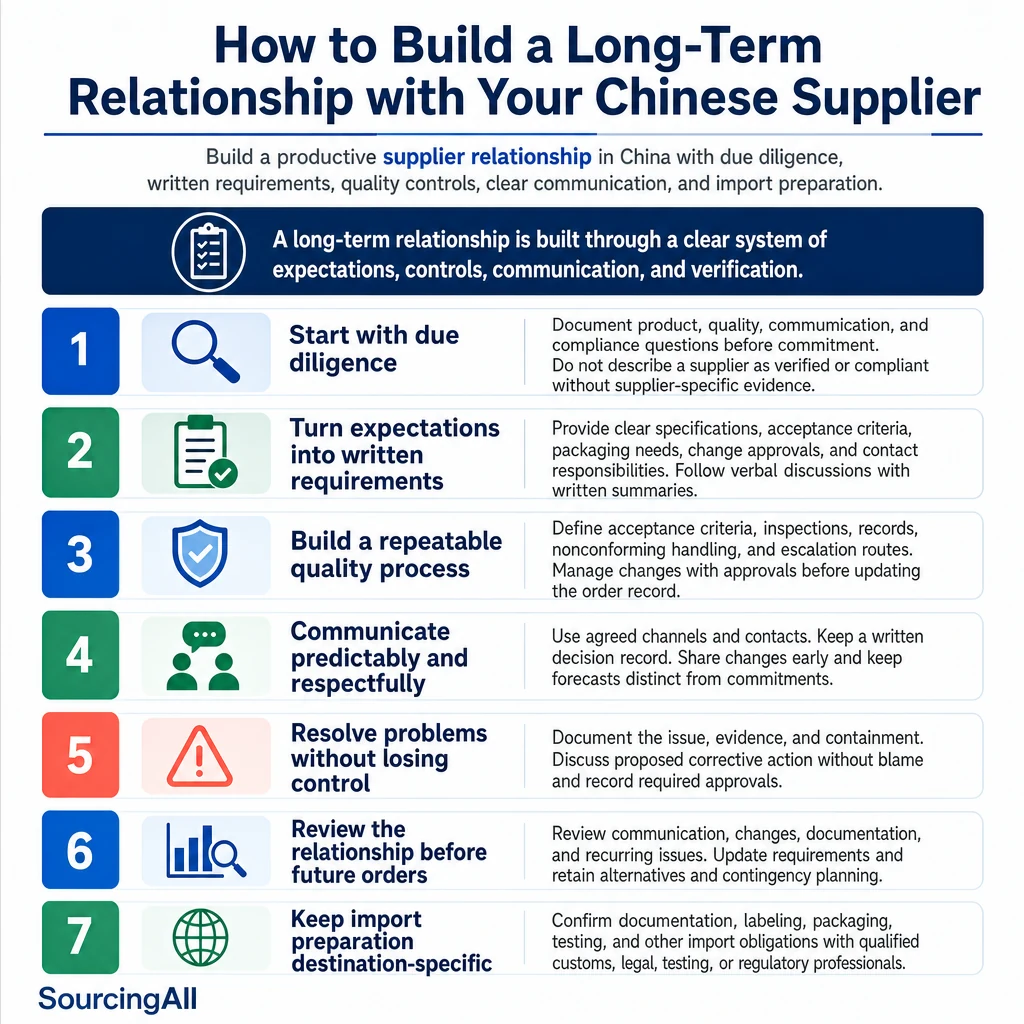
The goal is not to make the supplier relationship burdensome. It is to make important decisions traceable and understandable for everyone involved. When requirements, responsibilities, and escalation routes are documented, both parties have a clearer basis for managing routine work and addressing exceptions.
1. Start with due diligence before building commitment
A durable supplier relationship begins before an ongoing purchasing arrangement is established. Buyers need sufficient information to assess whether a prospective supplier can work within their documented product, quality, communication, and recordkeeping requirements. The appropriate review will depend on the product and destination market, but it should be deliberate rather than based on a promising conversation, an introductory document, or relationship history.
The International Trade Administration states that China market-entry planning should include robust due diligence and an understanding of local regulations. For supplier selection, this supports a practical discipline: understand the operating context, identify the evidence needed for the purchasing decision, and confirm applicable requirements before making commitments. Buyers can consult the International Trade Administration guidance on China market-entry strategy for that broader context.
Due diligence is an ongoing buyer responsibility, not a permanent label. A supplier should not be described as verified, compliant, reliable, ethical, or financially sound unless the buyer has evidence that is specific to that supplier and the work under consideration. An established relationship also does not demonstrate that a supplier can meet every new product requirement or destination-market obligation.
Begin with buyer-side questions. Document the product requirements, available quality information, communication process, expected records, packaging needs, change-handling process, and responsibilities of each party. This creates a more consistent evaluation process and gives the supplier a clearer view of the operating requirements it would need to follow.
General supplier relationship management is also relevant after selection. The American Public University System’s supplier relationship management guidance describes the importance of actively managing supplier and vendor relationships. In practice, that means maintaining a usable operating process rather than relying on goodwill or informal recollection.
2. Turn expectations into clear written requirements
Supplier disagreements do not always arise from bad intent. A requirement may have been discussed informally, interpreted differently, revised without documented approval, or never connected to an acceptance decision. Clear written requirements provide an operational foundation for the relationship.
Order documentation should state what is being supplied and how conformity will be assessed. Use specifications that can be understood by the people responsible for production and review. Where relevant, identify the approved-reference procedure, packaging expectations, required order documents, and the buyer contact responsible for decisions. If a requirement can affect acceptance, it should be traceable in the working record.
Change control deserves particular attention. Define the changes that require buyer approval before implementation, how a proposed change should be presented, who may approve it, and where the decision will be recorded. A material substitution, packaging revision, process change, or document update may affect the buyer’s requirements. Neither party should have to guess whether a change is acceptable.
Plain language is generally more useful than broad instructions. Instead of relying on terms such as “good quality” or “standard packaging,” describe the relevant requirement, the evidence used to assess it, and the responsible contact. Follow important verbal discussions with a written summary so the record reflects the agreed decision.
| Relationship stage | Buyer action | Control boundary |
|---|---|---|
| Supplier evaluation | Document product, quality, communication, and compliance questions before making an ongoing commitment. | Do not describe a supplier as verified or compliant without supplier-specific evidence. |
| Order setup | Provide written specifications, acceptance criteria, packaging requirements, change approvals, and contact responsibilities. | Written requirements can reduce ambiguity, but they do not eliminate production errors. |
| Production management | Maintain agreed quality controls and record material changes or deviations. | Controls support review and action; they do not guarantee conformity. |
| Issue resolution | Record the issue, evidence, containment action, proposed corrective action, and next approval. | Do not assign fault or treat a corrective action as effective without supporting evidence. |
| Future-order planning | Review recurring issues, communication patterns, documentation, and forecast changes before placing another order. | Repeat orders do not ensure priority capacity, fixed pricing, or delivery performance. |
| Import preparation | Confirm destination- and product-specific documentation and labeling needs with qualified advisors. | Do not generalize import guidance from one jurisdiction to another. |
3. Build a repeatable quality process
Trust is more useful when both parties understand how quality will be managed in practice. The buyer should define acceptance criteria, inspection responsibilities, required records, handling for nonconforming goods, and escalation routes appropriate to the product. These controls should continue after the relationship becomes familiar.
ISO quality-management requirements address control of externally provided processes, products, and services. That principle is relevant because externally supplied goods need a defined control approach rather than reliance on relationship history alone. The applicable details vary by product and buyer requirements, but a documented method can cover requirement review, communication of updates, management of nonconforming goods, and retention of relevant evidence. The underlying framework is available through ISO 9001 quality-management requirements.
An approved sample, certificate, or contract may be part of a control process, but none should be treated as proof that all future production will meet requirements. The more useful question is whether the requirement is current, understood, controlled, and tied to an agreed approval process.
For example, a buyer may require notice before a specified material or packaging element is changed. The supplier can present the proposed change, the buyer can review it against documented requirements, and the decision can be recorded before the order record is updated. This does not assure an outcome. It creates a clearer route for identifying and managing a change before it becomes a dispute.
4. Communicate predictably and respectfully
Respectful communication does not mean avoiding difficult subjects. It means raising requirements and concerns directly, factually, and through agreed channels. Predictability matters when buyers and suppliers work across distance, different working routines, and several operational contacts.
Agree on the channel for routine updates, the contacts responsible for operational decisions, and the method for recording approvals or exceptions. Keep a written decision record when a discussion affects specifications, packaging, documentation, or the next production step. This helps prevent important information from being left across disconnected messages.
Share relevant demand, design, and timeline changes as early as practical. Planning information can help a supplier understand what the buyer is considering, but it should not be presented as a purchase commitment unless that commitment has been made contractually. Keeping forecasts distinct from commitments reduces the risk of misunderstanding.
Feedback should be specific and tied to the agreed requirement. Identify the relevant record or evidence, state the decision needed, and avoid general accusations. Keeping the discussion connected to the work makes it easier to review the issue without making it personal or vague.
5. Resolve problems without losing control
Problems test the operating relationship. The objective is not to avoid every disagreement through goodwill. It is to respond in a disciplined way when an issue is identified. Start with a written description of the issue, the affected requirement, and the available evidence. Record any immediate containment action while the matter is reviewed.
Separate discussion of proposed corrective action from blame. Ask what action is proposed, which requirement or process it addresses, what documentation needs revision, and what approval is required before the next step proceeds. This does not presume a cause or the effectiveness of a proposed correction. It creates a record that can be reviewed before a future order relies on the change.
Where an issue may affect product safety, regulatory obligations, customs treatment, contractual rights, or other product-specific matters, buyers should seek advice from an appropriately qualified professional. The necessary response depends on the product and destination market and should not be assumed from a general supplier relationship.
6. Review the relationship before future orders
Periodic review helps keep a long-term relationship aligned with current requirements. Rather than considering only whether an order has been completed, review how the relationship is functioning: whether communication is clear, changes follow the agreed process, documentation is complete, and recurring issues need further attention.
This is also an opportunity to update buyer requirements. Product revisions, packaging changes, new destination markets, and revised internal responsibilities can make earlier instructions incomplete. Keeping the supplier informed does not mean reducing review. It means maintaining a current shared record of what the buyer requires.
Retain alternatives and contingency planning. A productive supplier relationship can be valuable, but it should not remove the buyer’s need to manage risk. Continue to assess the relationship against documented needs, and do not treat repeat business as a guarantee of quality, favorable commercial terms, compliance, priority production, or delivery performance.
7. Keep import preparation destination-specific
Import requirements vary by destination and product category. Buyers should confirm the documentation, labeling, packaging, testing, and other obligations relevant to their goods with qualified customs, legal, testing, or regulatory professionals.
For goods imported into the United States, U.S. Customs and Border Protection states that importers should exercise reasonable care so importations have accurate documentation, packaging, and origin labeling. Buyers handling U.S.-bound goods can review the agency’s guide for commercial importers. This source is specific to U.S. imports and should not be treated as advice for another destination or product category.
Buyers who need help organizing supplier evaluation, quality planning, documentation coordination, or logistics communication can review how SourcingAll works. For sourcing, quality coordination, or logistics support, use the request-a-quote form.