
You have a business license PDF in your inbox. The supplier sent it soon after you asked. That speed can feel reassuring, but a quick email tells you almost nothing about whether the document is real—or whether the company behind it can actually make your product.
The license alone is not enough. But if you learn how to read it, you get the first real check on whether this factory is who they say they are. Experienced China-sourcing operators use a step-by-step process that filters out a surprising number of fakes and shell companies without ever leaving their desk.
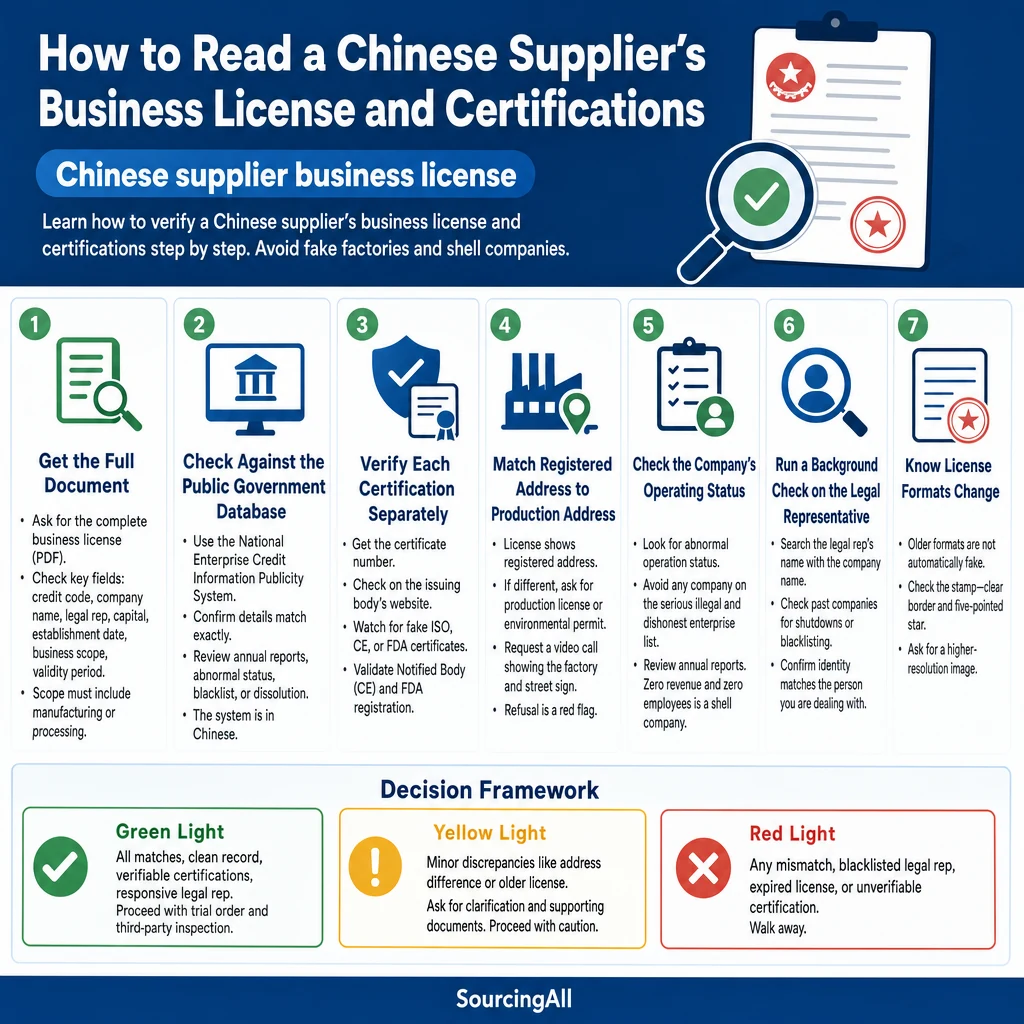
1. Get the Full Document, Not a Cropped Photo
Ask for the complete business license (营业执照 – yíngyè zhízhào) as a PDF. Do not accept a screenshot, a WeChat image, or a photograph of a photocopy. A full PDF lets you zoom in on the official stamp (公章 – gōngzhāng), the serial number printed by the local Administration for Market Regulation (AMR), and the watermark patterns.
What you are looking for on the document itself:
| Campo | Qué comprobar | Red Flag Example |
|---|---|---|
| Unified Social Credit Code (统一社会信用代码) | Unique alphanumeric code. First character indicates enterprise type. | Code length is wrong, contains characters that are not used in legitimate codes. |
| Company Name (公司名称) | Must exactly match the name on your quote, the supplier’s website, and any Alibaba store. | Different legal name than their trading name. Many factories trade under a brand but are registered under a different entity. |
| Legal Representative (法定代表人) | Real person who is legally responsible for the company. Must be a Chinese citizen. | The person you are dealing with is not the legal rep and cannot explain who the rep is. |
| Registered Capital (注册资本) | Declared in RMB. Higher capital usually means more financial commitment, not necessarily better production. | Extremely high capital for a tiny workshop (often inflated) OR very low capital (suggests a shell with no assets). |
| Date of Establishment (成立日期) | How long the company has been registered. | Very recent registration (e.g., within the past few months) with no track record. |
| Business Scope (经营范围) | Must include manufacturing (生产) or processing (加工) for your product category. | Scope only lists “sales” or “trade”—they are a trading company, not a factory, even if they claim otherwise. |
| Validity Period (营业期限) | Stated as “long-term” (长期) or a fixed date. | Expired license. Many suppliers simply forget to renew; ask for the updated version. |
2. Check the License Against the Public Government Database
China operates a free, publicly accessible online system: the National Enterprise Credit Information Publicity System (国家企业信用信息公示系统). You do not need to register. Enter the full credit code or the company name in Chinese characters.
What the database shows you.
- All the same details that appear on the license
- Annual reports the company has filed
- Any “abnormal operation” status
- Whether the company is listed on the “serious illegal and dishonest enterprise” blacklist
- Whether the company has been deregistered or dissolved
If the license details do not match the online record exactly—even one character different in the company name—stop. That is a proven red flag. The U.S. Trade Representative, in its 2017 report to Congress on China’s WTO compliance, specifically noted that misleading license documents and company documentation have been a source of serious trade friction. Factories using doctored licenses are exactly the kind of problem that report flagged.
Practical limitation. The system is in Chinese. You will need to copy-paste the characters. If you do not read the language, ask a colleague or hire an agent. Machine translation works for the main fields but not for legal notices.
3. Verify Each Certification Separately
Suppliers often claim to hold ISO 9001, CE, FDA, or other certifications. These are rarely printed on the business license itself—only legally required permits (like food production licenses) appear there. Most certifications are separate documents.
For each certification:
- Note the issuing body (e.g., SGS, TÜV, BSI for ISO; a specific Notified Body number for CE)
- Go to that body’s online verification portal
- Enter the certificate number
If the supplier will not give you a certificate number, or the number does not appear in the database, the certification is likely fraudulent.
Common traps.
- ISO 9001: Many Chinese factories buy fake certificates from non-accredited bodies for a few hundred dollars. Only certificates from bodies recognized by the International Accreditation Forum (IAF) or national accreditation services hold weight. Look for the accreditation mark.
- CE marking: The supplier must provide a Declaration of Conformity and a technical file. A simple CE sticker on the product is not enough. Validate the Notified Body number against the European Commission’s NANDO database.
- FDA registration: For food-contact materials or medical devices, FDA registration is facility-specific. Ask for the establishment registration number and check it on the FDA website. Note: many Chinese factories register with FDA but do not actually comply with U.S. manufacturing standards.
4. Match the Registered Address to the Production Address
The license shows the registered address (注册地址). For a real factory, this should be the same as the production address (生产地址). In practice, many companies register an office address while the actual factory is in a different district or province.
How to handle this.
- If the addresses differ, ask for the production license or environmental permit, which will list the actual production site.
- Request a video call showing the factory floor and the street sign outside.
- If they refuse, treat it as a significant risk.
A supplier that operates from a different location than its registered address is not necessarily fraudulent—small factories often use a business address for registration and a separate workshop for production. But it adds complexity. You cannot rely on the license alone to confirm where your goods will be made.
5. Check the Company’s Operating Status
On the government credit system, look for these statuses:
- 列入经营异常名录 – Listed as operating abnormally. This usually happens because the company failed to file annual reports, didn’t update a change of address, or ignored a regulatory notice. Not automatically a dealbreaker, but requires an explanation.
- 严重违法失信企业名单 – Serious illegal and dishonest enterprise list. This is a blacklist. Do not work with any company on this list.
Even if the status looks clean, check the annual reports. A company that has filed three consecutive reports with zero revenue and zero employees is almost certainly a shell. You want to see revenue figures that make sense for the volume of orders they claim to handle.
6. Run a Simple Background Check on the Legal Representative
Search the legal representative’s name together with the company name. In China, the legal representative is personally responsible for the company’s obligations. If that person has been the legal rep for multiple companies that were shut down or blacklisted, that is a warning.
You can also check whether the legal representative’s identity number (available through the credit system) matches the person you are communicating with. Some fake factories use a borrowed or stolen identity for registration.
7. Know That Older License Formats Are Not Automatically Fake
The Chinese government has updated the license template several times over the years. A license issued several years ago with a different font or watermark pattern does not mean it is fake. But if the supplier gives you an old-style license for a company that was supposedly established recently, that is a mismatch worth questioning.
Also examine the red stamp. A genuine AMR stamp will have a clear border and a five-pointed star at the center. On a low-quality scan, the detail may be blurry. Ask for a higher-resolution image.
As the supplier-vetting blog ChineseCheck notes in its guide to red flags when sourcing from China, suppliers who are unwilling or unable to provide clear, verifiable license documentation are among the top warning signs. The same source recommends that if the license verification process reveals any inconsistency, you should treat it as a potential dealbreaker unless you can independently confirm the factory’s capability through a physical visit or a trusted third party.
Putting It Together: The Decision Framework
You now have the license, the online record, and the certifications. What do you do?
Green light. All fields match, online record is clean, certifications are verifiable, and the legal representative is responsive. Proceed with a small trial order or sample request. Still arrange a third-party inspection.
Yellow light. Minor discrepancies—registered address differs from production address, or the license is older without recent annual reports. Ask for clarification. If the supplier provides reasonable supporting documentation (e.g., separate production license), proceed with caution.
Red light. Any mismatch between the license and the online record, a blacklisted legal representative, expired license, or a certification that does not verify. Walk away. Thousands of other factories in China are legitimate. The cost of a bad order—defective goods, late delivery, or outright fraud—far exceeds the time spent vetting the next supplier.
What to Do If You Cannot Verify Yourself
If you do not speak Chinese and do not have a trusted agent in China, you can still do the basics—check the credit code format, look for the official stamp, and ask for a video call. But deeper verification (government database, legal representative background, certification authenticity) requires someone on the ground or a service that specializes in supplier vetting.
That is where a company like Abastecimiento de todo comes in. Our auditors visit factories, check original licenses against government databases, and confirm production capacity. For a small business that cannot afford to fly to China, using a sourcing partner that includes license verification as part of its standard process is often the most cost-effective way to reduce risk.
If you are ready to verify your current supplier or want help finding a reliable one, describe your product requirements and get a quote. The time you invest upfront will save you from the headache of a shipment that arrives with the wrong materials, the wrong dimensions—or no supplier to call when something goes wrong.