
You found a supplier on Alibaba or at a trade show. They quote you a price per unit for a full order, but you have never held the product. The listing photos could be stock images. The description might be generic. Do you trust that and send your money on trust alone?
The smart move is to order one sample first. But sample sourcing is not automatic. It is a mini-project with clear criteria and records. If you skip the sample step, you risk receiving goods that do not match your expectations, and returns from China are painful. Here is how to approach sample procurement like an experienced operator.
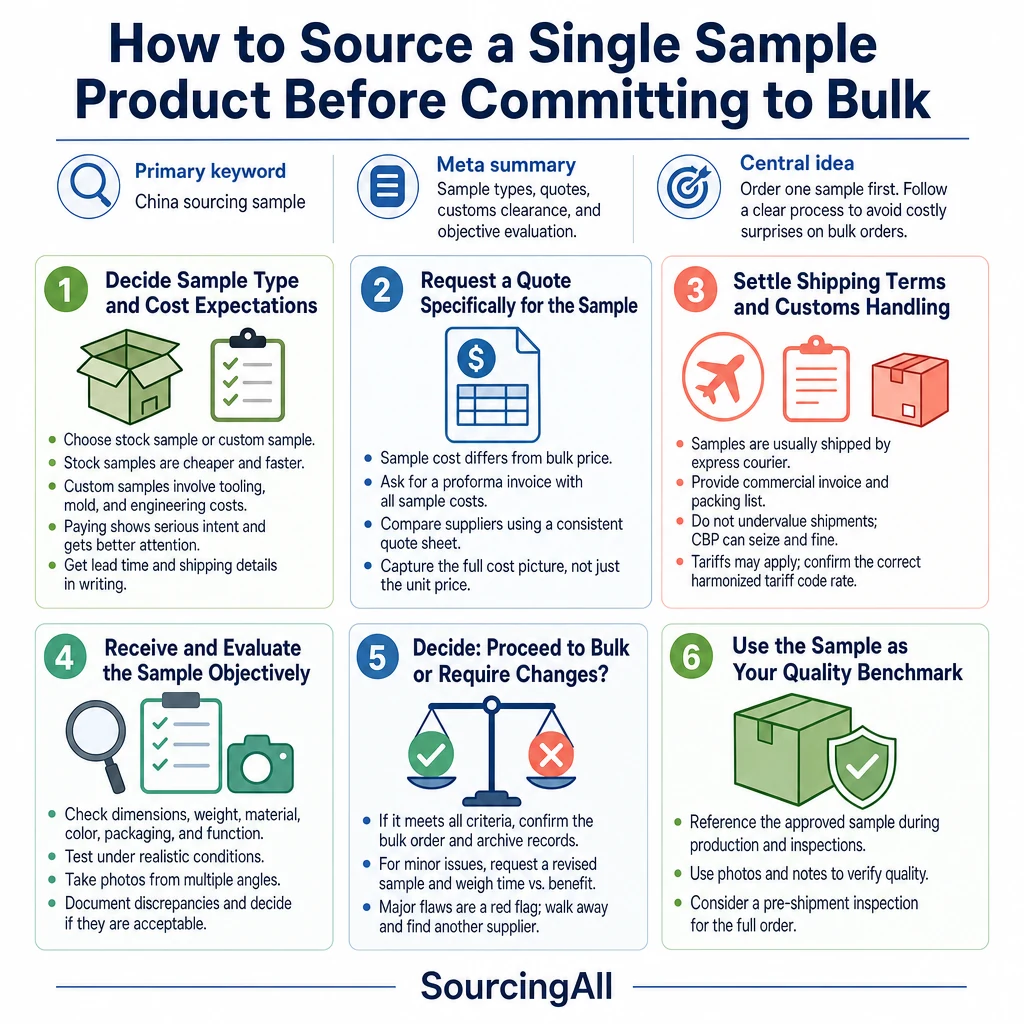
1. Decide Sample Type and Cost Expectations
Start by deciding between a stock sample and a custom sample. A stock sample is an existing product the supplier already makes. They pull a unit off the shelf or from a production batch. This is usually the cheapest and fastest option. You can often get a stock sample for little more than shipping, sometimes even free.
A custom sample is made to your specification. It requires the supplier to adjust tooling, change materials, or create a new mold. This costs money. Mold fees, setup charges, and engineering time add up quickly. Do not expect a custom sample for free. As noted by SDI Export Services in their guide on China sourcing cost control, sample procurement is part of a complete purchasing process, not a separate freebie.
Paying for a sample signals serious intent. A supplier who sees that you are willing to invest a moderate amount up front is more likely to take your order seriously. If you press for a free sample on a custom product, the supplier may rush a low-quality sample just to get you off their back. Paying often gets you better attention and a more accurate sample.
Before agreeing to anything, ask: Is this an existing product or a modification? What is the lead time for the sample? Is shipping included or separate? Get these answers in writing.
2. Request a Quote Specifically for the Sample
The bulk price is usually not the same as the sample cost. Many suppliers add a handling fee or a small-batch surcharge for a sample unit. Ask for a formal proforma invoice that itemizes the sample unit price, any tooling or mold cost, packaging, and the shipping method. Experienced suppliers will provide this without pushback.
If you are comparing multiple suppliers, record the details in a consistent format. The table below shows what fields matter. Fill it in as you receive quotes. This sheet will be your sanity check when you evaluate later.
| Nombre del proveedor | Sample Type | Sample Unit Cost | Tooling/Mold Fee | Método de envío | Costo de envío | Estimated Delivery Days | Condiciones de pago | Notas |
|---|---|---|---|---|---|---|---|---|
| [Name] | Stock / Custom | Courier / Air / Sea | T/T, PayPal, etc. | e.g., sample fee refundable on bulk | ||||
| [Name] | Stock / Custom | Courier / Air / Sea | T/T, PayPal, etc. | e.g., free sample but buyer pays shipping |
Leave the number cells blank in your own document until you get real figures. The point is to capture the full cost picture, not just the sample unit price.
3. Settle Shipping Terms and Customs Handling
Samples from China are typically shipped via express courier, DHL, FedEx, UPS. The supplier will arrange pickup and billing. You need to decide who pays the shipping cost and who bears the risk of loss in transit.
For imports into the United States, the U.S. Customs and Border Protection (CBP) publication Importing into the United States: A Guide for Commercial Importers explains that courier shipments may qualify for informal entry procedures. This means less paperwork and lower processing fees for low-value commercial samples. You will need to provide a commercial invoice and a packing list. The courier’s brokerage service can usually handle customs clearance on your behalf.
Be aware of a common pitfall: some suppliers will mark the package as “commercial sample” or “no commercial value” to keep the declared value low. Undervaluing merchandise to avoid duties is risky. CBP can seize undervalued shipments, fine the importer, and flag your company for future inspections. It is not worth the saving. Pay the legitimate duties, which are generally modest on small packages.
Tariffs are a factor. The Council on Foreign Relations, in its backgrounder on the U.S.-China trade relationship, notes that trade barriers and tariffs remain a key dynamic. Depending on the product category, your sample may be subject to additional duties. Ask your courier or customs broker to confirm the correct harmonized tariff code rate.
Offer to provide the supplier with a clear commercial invoice template that includes your company name, product description, unit value, and country of origin. This reduces confusion and speeds up delivery.
4. Receive and Evaluate the Sample Objectively
The package arrives. Set it aside for a structured evaluation rather than judging it on first glance.
Compare the sample against the specifications in the quote. Measure dimensions, weigh it, check material, color, and packaging. For functional items, test it under realistic conditions. If it is a garment, wash it. If it is electronics, run a full usage cycle. Take photos under consistent lighting and from multiple angles. These images become your reference for future production inspections.
Document any discrepancies. If the sample differs from the quote in a way that matters, decide whether you can accept it or need a corrected sample. Sometimes a minor deviation is fine. For example, a small dimensional difference in a piece of furniture might be acceptable; a wrong color match in a branded product is a hard no.
SDI Export Services emphasizes that sample evaluation is a verification step before bulk scaling. It is your last chance to catch problems without losing a production run.
5. Decide: Proceed to Bulk or Require Changes?
If the sample meets all your criteria, you have a green light. Confirm the bulk order with the supplier, referencing the sample as the quality benchmark. Archive the sample, the original quote, and your evaluation notes. These will be used during pre-shipment inspection to verify that the mass-produced goods match the approved sample.
If there are minor issues, you can request a revised sample. Be prepared for additional cost and time. The supplier may ask you to pay for the second sample or only for shipping. Decide whether the issues are worth the delay.
If major flaws appear, wrong material, poor workmanship, missing features, consider it a red flag. A supplier that cannot deliver a correct single sample is unlikely to deliver many correct units. Walk away and look for another supplier.
You now have a physical sample in hand that matches your expectations. The next decision is whether to move forward with a pilot bulk run. If you are unsure about supplier reliability for the full order, consider a pre-shipment inspection. SourcingAll can help coordinate that checkpoint, learn how we work.