
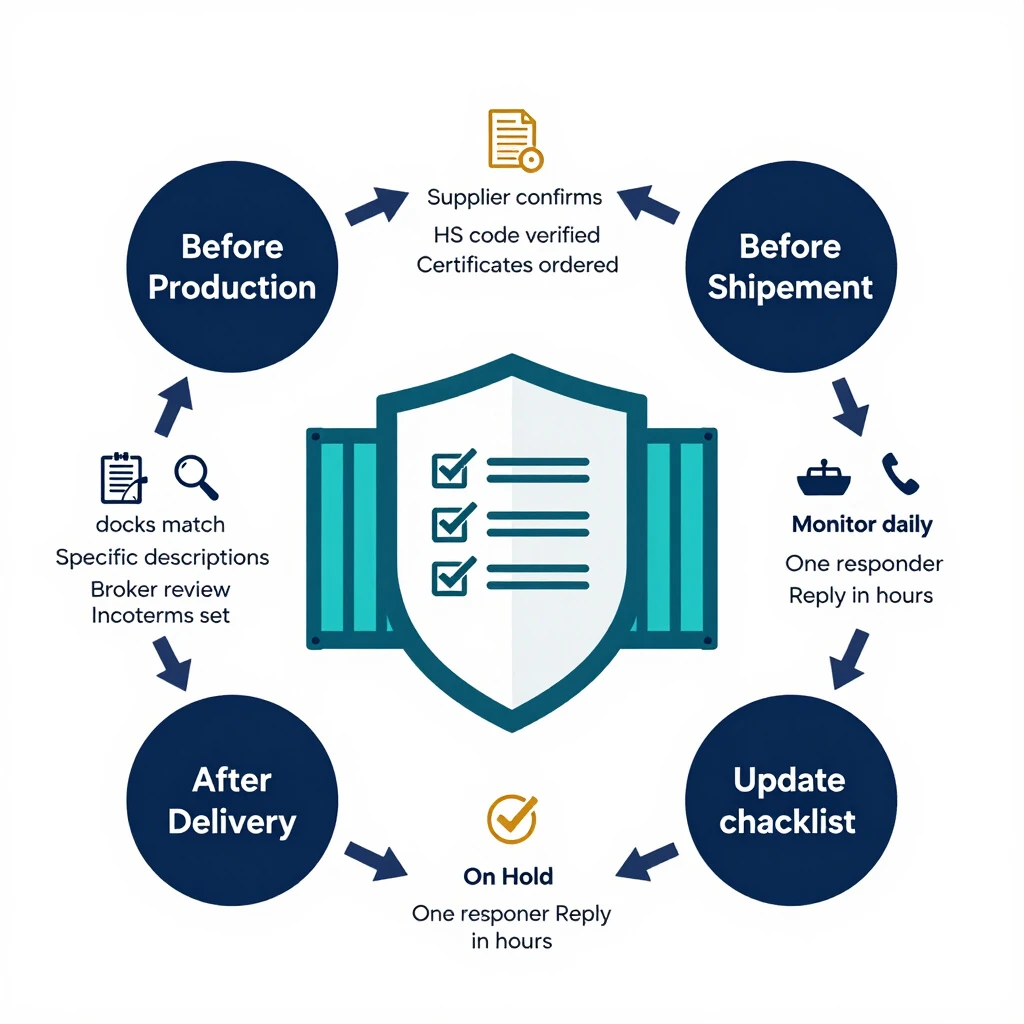
Say the supplier confirms the goods are ready and the freight forwarder has booked the container. Then the shipment stops moving. Customs at the origin port or destination has flagged something: a document mismatch, an unclear product description, or a classification that does not match the cargo. The container sits, storage charges accumulate, and the launch date slips. This is a hypothetical scenario, not any specific shipment.
Most avoidable customs delays come from paperwork and compliance decisions made before the goods ship. Accurate documentation, verified HS codes, written supplier instructions, and a broker or forwarder who reviews the file in advance cannot guarantee clearance. They can prevent many of the administrative holds that happen when information is incomplete, inconsistent, or hard to verify.
1. What goes into a clean export package?
Requirements vary by destination and product, but incomplete or inconsistent paperwork is the kind of problem you can catch early. A standard export package contains the commercial invoice, the packing list, and the bill of lading. If the weights do not match, or the product description on the invoice differs from the packing list, or the consignee name is spelled differently across documents, customs may hold the shipment for clarification. That is a hypothetical example of a documentation-related hold.
Ask your supplier to confirm all three documents are accurate before the shipment leaves. Product descriptions should be specific enough for an officer who has never seen the product to understand what it is. “Electronic components” is weaker than “LED driver circuit board, model X-200, 12V DC input.” The description should match the cartons.
Ask the supplier to send the export documents early, ideally before the goods leave the factory. Review them yourself or pass them to your freight forwarder or customs broker for a pre-shipment check. A broker can spot many problems before shipment, when they are cheaper and faster to fix than after the container is on the water.
Documentation requirements differ by destination country and product. The guidance here is general, not legal advice. When in doubt, ask the broker or forwarder handling the shipment.
2. How do you confirm the right HS code?
The HS code is a product classification used in international trade to identify goods. It helps determine the duties, taxes, and checks that apply to a shipment. An incorrect code can cause a hold. That may happen if the supplier gave a generic code, the buyer guessed, or the product changed between samples and production. Treat that as a hypothetical illustration, not a specific case.
Check the HS code with your supplier, freight forwarder, or customs broker before shipping. If you import the same product repeatedly, re-verify the code when the product changes. As a general rule, a product with a motor, a battery, or a chemical component may fall into a different category than a purely mechanical version.
Compliance goes beyond classification. Ask whether the product needs certificates, licenses, or special labeling for the destination market. Depending on product and destination, that can include test reports, certificates of origin, or registration numbers. Ask the supplier whether they can provide these documents and whether they have exported this product to your country before.
Keep records of product specifications, test reports, and correspondence about the product. If customs asks for evidence that the goods match the declaration, you want to be able to produce it the same day.
Hypothetical example: a buyer declares a rechargeable fan under a general plastics code. Customs opens the container, sees the battery, and holds the shipment for reclassification under a code requiring a battery certificate. The delay could have been avoided by checking the code before shipping. This is an illustration; no specific code outcome is guaranteed.
3. Why put your requirements in writing?
Suppliers often manage many orders at once. Your specific requirements may not stay at the top of their mind if you only discuss them on a phone call. Write the requirements down and send them before production.
A written checklist should include the documents you need, the shipping marks you want on cartons, and any labeling or packaging rules for the destination country. Ask the supplier to confirm in writing that they can meet every item. If they cannot, you find out before production, not after the goods are packed.
The purchase order or contract should state who is responsible for each document. If the supplier handles the commercial invoice and packing list, say so. If you are providing the HS code, say that too. That allocation prevents the “I thought you were handling that” conversation while the container is at the port.
If you work with a sourcing partner, they can coordinate these requirements with vetted suppliers on your behalf. SourcingAll provides supplier search and vetting, sample coordination, product development, production monitoring, quality inspection, and logistics coordination for international buyers. See the SourcingAll services page for the full scope.
4. Which Incoterms should you use?
Incoterms are a framework for who arranges and pays for shipping, insurance, and documentation at each stage, and where risk transfers from seller to buyer. The term you choose affects who prepares the export documents and who deals with customs at origin.
Under some terms the supplier handles more of the export process. Under others the buyer takes over earlier. Neither is automatically better. What matters is that both parties understand the chosen term and what each side must provide.
If you are new to importing, ask your freight forwarder to explain the practical difference between the terms you are considering. A term that looks cheaper on paper may put more documentation work on you. A logistics partner can help you select terms that reduce friction at customs without overcomplicating the commercial arrangement.
The specific obligations for each term are defined in the Incoterms rules. Your forwarder or broker can confirm what applies to your shipment.
5. Do you need a customs broker or freight forwarder?
You can import without a customs broker, but you take on the job of getting the paperwork right. A customs broker reviews your documents, helps confirm the classification, and submits the entry to customs. Their job is to know what the local customs office expects.
A freight forwarder coordinates the physical movement of the shipment and communicates with carriers. Some forwarders also have brokerage arms or work with brokers. If you use one company for both, you get a single point of contact for the shipment.
When choosing a broker or forwarder, ask about their experience with imports from China. Ask how many shipments they handle from that origin, whether they have dealt with your product category, and how they handle document requests from customs. Their answers tell you whether they will catch problems before you hit them.
Not every shipment needs a broker. If you are importing a simple product with a straightforward HS code and a supplier who has exported to your country many times, you may manage fine without one. The tradeoff is that when something goes wrong, you are the one responding to customs.
If you prefer a single partner who coordinates the whole process, SourcingAll offers logistics coordination as part of its services, alongside supplier vetting and quality inspection. That means the same team that vetted your supplier can help you manage the shipment and the documentation around it.
6. How do you track a shipment and respond to customs requests?
A shipment can move smoothly from the factory to the port and then be held at customs for clarification. Customs may ask for more information or a corrected document. How quickly you respond can affect how long the hold lasts.
Monitor the shipment status through your forwarder or carrier. They should provide tracking updates by email or through an online portal. If the status changes to “held” or “under review,” find out what customs needs and who is responsible for providing it.
Keep digital copies of every document related to the shipment: commercial invoice, packing list, bill of lading, certificates, test reports, and correspondence with the supplier. Store them in a folder you can access from your phone. When customs asks for a document, you want to send it within hours, not days.
Designate one person on your team to handle customs follow-up. If that person is you, set a daily check on the shipment status while it is in transit. Hypothetical example: a missing signature on a commercial invoice can cause a hold until the document is corrected and resubmitted.
7. How do you plan for inspections and contingencies?
Customs may select some shipments for inspection. Selection can be random or based on risk factors such as product type, origin, declared value, or the importer’s history. You cannot control which shipments get inspected, but you can control how prepared you are.
Build extra lead time into your schedule, especially for new products, new suppliers, or first-time imports. If your supplier has never exported to your country, expect that the first shipment may take longer. Add a buffer of days or weeks depending on the product and destination. That buffer is the price of learning.
Have a contingency plan for unexpected holds. That might mean keeping safety stock in your destination country, using a faster shipping method for a reorder, or having a backup supplier who can produce the same product. The right contingency depends on how critical the shipment is to your business.
From a practical standpoint, a sourcing partner that provides production monitoring and logistics coordination can help you spot and address issues earlier. No strategy can definitively avoid customs holds, but preparation can help limit their impact.
8. What should you review after delivery?
After the shipment clears and the goods arrive, take fifteen minutes to review what happened. Note any documentation issues, close calls, or questions from customs. If the supplier’s packing list had errors, tell them. If the HS code needed correction, update your records.
Keep a running checklist for each product and supplier. The checklist becomes more accurate with every shipment. Share it with your supplier so they know exactly what you expect.
If you work with a sourcing partner, they can help refine the process over time. For more on how SourcingAll supports that work, see the How SourcingAll works page.
9. Customs Delay Prevention Checklist
Print this and keep it with your order file.
| Stage | Checkpoint |
|---|---|
| Before production | Supplier confirms in writing that they can meet your document, labeling, and packaging requirements. |
| Before production | HS code verified with supplier, forwarder, or broker. |
| Before production | Certificates, licenses, and test reports identified and ordered. |
| Before shipment | Commercial invoice, packing list, and bill of lading match each other. |
| Before shipment | Product descriptions are specific and consistent across all documents. |
| Before shipment | Export documents reviewed by broker or forwarder. |
| Before shipment | Incoterms agreed and documentation responsibilities assigned in the purchase order. |
| In transit | Shipment status monitored daily. |
| In transit | Digital copies of all documents accessible from phone. |
| On hold | Designated person responds to customs requests within hours. |
| After delivery | Documentation issues logged and supplier feedback sent. |
| After delivery | Checklist updated for the next shipment. |
Customs delays can come from one significant error or from small issues that were caught too late: a document that does not match, a code that was never verified, a requirement that was discussed but never written down. The checklist above covers the points where those errors can happen.
If you would rather have a team handle supplier vetting, documentation coordination, and logistics for you, SourcingAll can help. Get a quote to discuss your next shipment, or check the FAQs for answers to common sourcing questions. You can also browse related articles for more guidance on importing from China.