
Here is a situation most importers recognize the moment it is too late. You ordered a product from a Chinese factory, production has run for most of the schedule, and the supplier sends a message saying the order is nearly ready. You have not booked an inspection. The factory suggests skipping it to save the date, and your balance payment is due.
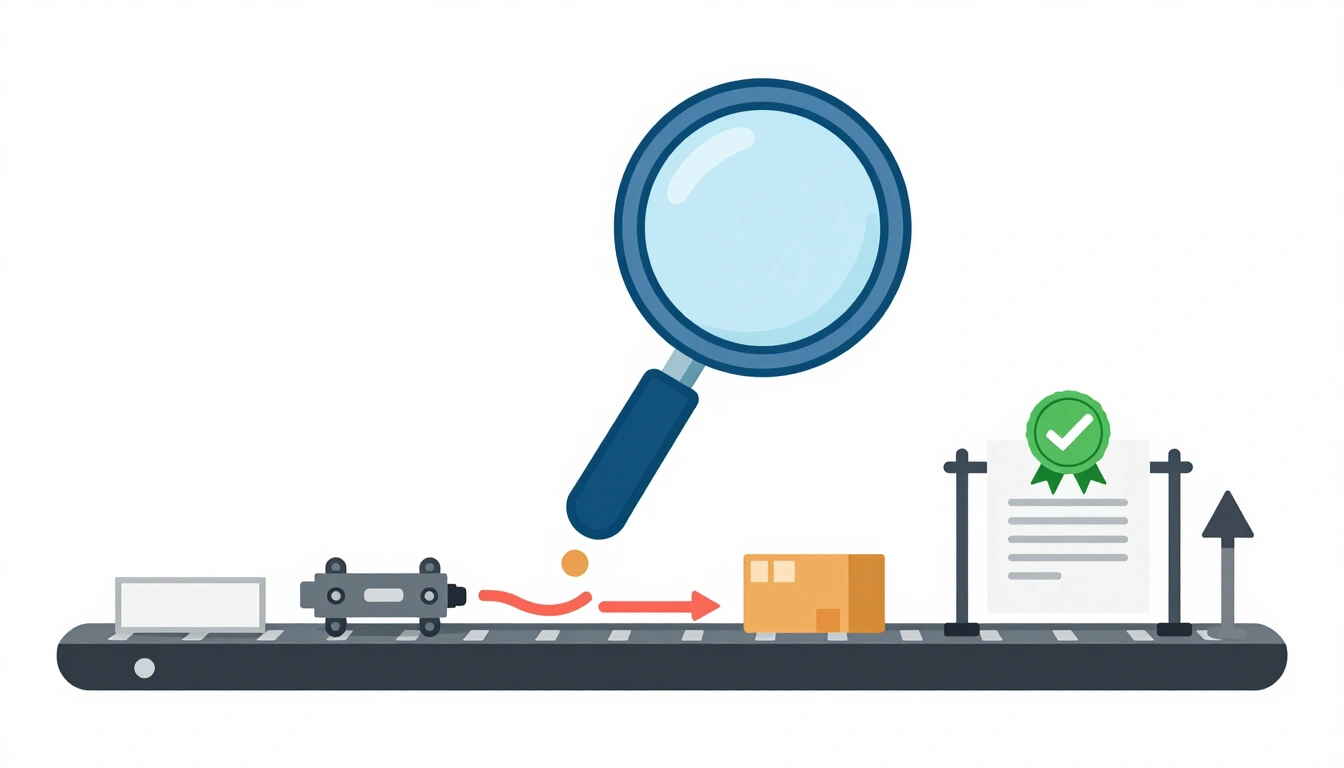
In-line vs. final inspection is not a contest between two levels of thoroughness. The real difference is timing and scope. An in-line inspection happens during production, at checkpoints you choose before the run starts. A final inspection, often called a pre-shipment inspection, happens after production is complete, usually within days of shipment. You book in-line when you need to catch a defect early enough to fix the process. You book final when you need evidence that the packed goods match your requirements before you release payment.
What changes between the two inspections
Think of the difference as the difference between watching the kitchen and tasting the finished dish. An in-line inspection checks that the materials, workmanship, and assembly are going in the right direction while the factory can still change course. A final inspection checks what actually came out of the kitchen, but by then the only options are rework, discount, rejection, or serving something you do not want.
In practice, an in-line inspection is a series of agreed checkpoints. The inspector might arrive after raw materials arrive to confirm they match your approved sample, stand at the first article to catch a tooling problem, walk the line mid-production to check dimensions and workmanship, or stop before packing to verify labels, packaging, and accessories. Final inspection is one event after all production is complete. The inspector selects a random sample from the finished lot, checks the goods against your requirements, classifies defects, and gives you a report.
Both use sampling. Neither gives you a guarantee that every single piece is perfect. The question is where you want to place your limited inspection budget: at the point where problems are still correctable, or at the point where you need a document to support a commercial decision.
What an in-line inspection catches
An in-line inspection catches process defects while they are cheap to fix. If the factory is assembling a product with the wrong screw, or a print job is drifting off color, you want that found while the line is still running. The inspector can stop the line, talk to the production manager, and confirm the adjustment before thousands of pieces are made.
Consider a hypothetical example: a cosmetics brand orders a new pump bottle, and the factory uses a cheaper adhesive for the label at the pre-pack stage. The defect is invisible in a photo of finished cartons, but an in-line inspection at the pre-pack checkpoint catches the wrong adhesive before the bottles are sealed. The correction costs a roll of labels and an hour of line time. Discovered after the order is packed, the correction costs sorting, re-labeling, or replacement.
What an in-line inspection does not do is verify the final, sealed, ready-to-ship carton. It also covers only the stages you booked. A single visit at the start of production tells you nothing about the last week of the run. If you want coverage across the whole production window, you are buying either multiple inspections or continuous production monitoring, and the cost reflects that.
What a final inspection proves
A final inspection, in the pre-shipment sense, is a random sampling of finished, packed goods. The inspector checks quantity, appearance, workmanship, function, measurements, color, packaging, and carton markings against your specification. Defects are classified into critical, major, and minor, and the pass or fail decision is tied to an acceptable quality limit you agree in advance.
The value of a final inspection is not only that it finds defects. It gives you a third-party record at the exact moment your leverage is highest. Before you release the balance payment or before the goods leave the factory, that report is your evidence for a discount, a rework request, a hold, or a rejection. After the goods are on the water, your leverage drops and the conversation becomes much harder.
The structural limit of a final inspection is that it discovers systemic problems only after the whole run is complete. If the factory swapped a material mid-production, the final inspection may catch it, but every piece in the lot is now suspect. Sorting, rework, and rejection are all more expensive than a line-side correction would have been.
In-line vs. final inspection side by side
| Decision point | In-line inspection | Final inspection |
|---|---|---|
| When it happens | During production, at agreed checkpoints | After production, before shipment |
| What it checks | Materials, first article, work in progress, pre-pack | Finished goods, quantity, packaging, carton markings |
| Sampling logic | Fewer units, checked at each stage | Random sample from the completed lot |
| Main benefit | Defects are still correctable | Documentary evidence before payment and shipment |
| Main limitation | Only covers the stages you booked | Finds problems only after the whole run is done |
| Cost direction | Higher when multiple visits are needed | Lower per order, single visit |
| Best for | New factories, complex products, large orders, high failure cost | Known suppliers, repeat orders, simple products |
How to choose for your order
Start from the cost of failure, not the cost of the inspection. If this order arrives defective, what happens to your business? If the answer is a lost sales season, a damaged brand, or a penalty from your own customer, book an in-line inspection. If the answer is a few annoying returns and a refund, a final inspection is probably enough.
Book an in-line inspection when:
- The factory has never produced this product for you before.
- The product has electronics, moving parts, or tight tolerances.
- The order is large enough that a systemic defect would be financially painful.
- You are using new tooling, new material, or a new component.
- Production is spread across multiple weeks and you need early warning.
Book a final inspection only when:
- You have a documented history of good quality with this factory and this product.
- The product is simple, low risk, or inexpensive to replace.
- Your main concern is quantity, packaging, and basic conformity.
- You have the time and budget to remedy a bad lot, rather than prevent one.
A reasonable middle path is one in-line inspection at the highest-risk stage plus a final inspection. The highest-risk stage is usually the first article, when the line is unstable, or pre-pack, when shortcuts tend to appear. That combination catches the two moments where defects are most likely to become permanent: the beginning and the packing stage.
There are narrow cases where you can skip inspection entirely. If the product is the same, the factory is proven, and the failure cost is low, another inspection report may add little. Very small orders may not justify the logistics of a visit. What you should never skip is the specification. An inspection is only as useful as the document it is measured against.
How to brief the inspector
An inspection report is a tool, and the tool is only as good as the briefing behind it. Before the inspector enters the factory, send the following in writing:
- Your product specification. Technical drawings, approved samples, color chips, material references, and packaging artwork. The inspector checks against this document, not against memory or opinion.
- Your defect classification. Tell the inspector which defects are critical, which are major, and which are minor for your product. A scratch on a hidden surface may be minor to you; the same scratch on a visible surface may be major.
- The exact inspection stages and dates. For in-line work, agree whether the inspector arrives after materials, at first article, mid-run, or before packing. A visit that lands on the wrong day wastes your money.
- Your decision rules. Define what triggers a fail, a rework, a hold, or a discount. If you do not state these in advance, you will negotiate them after the report arrives, which is the worst time to negotiate.
- The reporting format. Require photos of each defect, quantities checked, and a clear pass or fail statement per section. A report without photos is much harder to use in a dispute.
Also understand what an inspection company will not do. Reporting companies issue findings; they do not usually fix production. If the report shows major defects, someone still has to make the factory correct them. That someone is you, your supplier, or an agent working on your behalf.
Questions buyers ask
Is a final inspection enough for a first order from a new factory? It can catch defects, but it leaves you no time to correct a systemic problem before shipment. A first order from a new factory is exactly the situation where an in-line inspection is most defensible.
Does an in-line inspection replace a final inspection? Not automatically. Many buyers run one in-line check plus a final check because the two cover different stages. In-line catches the process; final catches the packed product.
Do inspectors stay for the whole production run? Usually not. Inspections are sampling events at agreed times. If you need continuous oversight over multiple days or shifts, you are describing production monitoring, which is a different and more expensive service.
Who is responsible for a defect the inspection missed? The inspection contract defines the inspector’s liability, and it is usually limited to the cost of the inspection itself or a portion of the order value. The buyer remains responsible for the specification, the factory for the goods, and the shipping terms decide who bears risk in transit. Know those limits before you treat a report as a guarantee.
The question is not which inspection is better. It is which inspection gives you control at the moment you can still act. If the product is complex, the factory is new, or the failure cost is high, pay for early warning. If the product is simple and the supplier is proven, book the final check and save the budget. And before you do either, write the specification first. An inspection without a spec is just someone’s opinion.
If you want help setting the right checkpoints and reading the report afterward, SourcingAll’s quality inspection service covers supplier vetting, spec review, and inspection coordination for international buyers.