
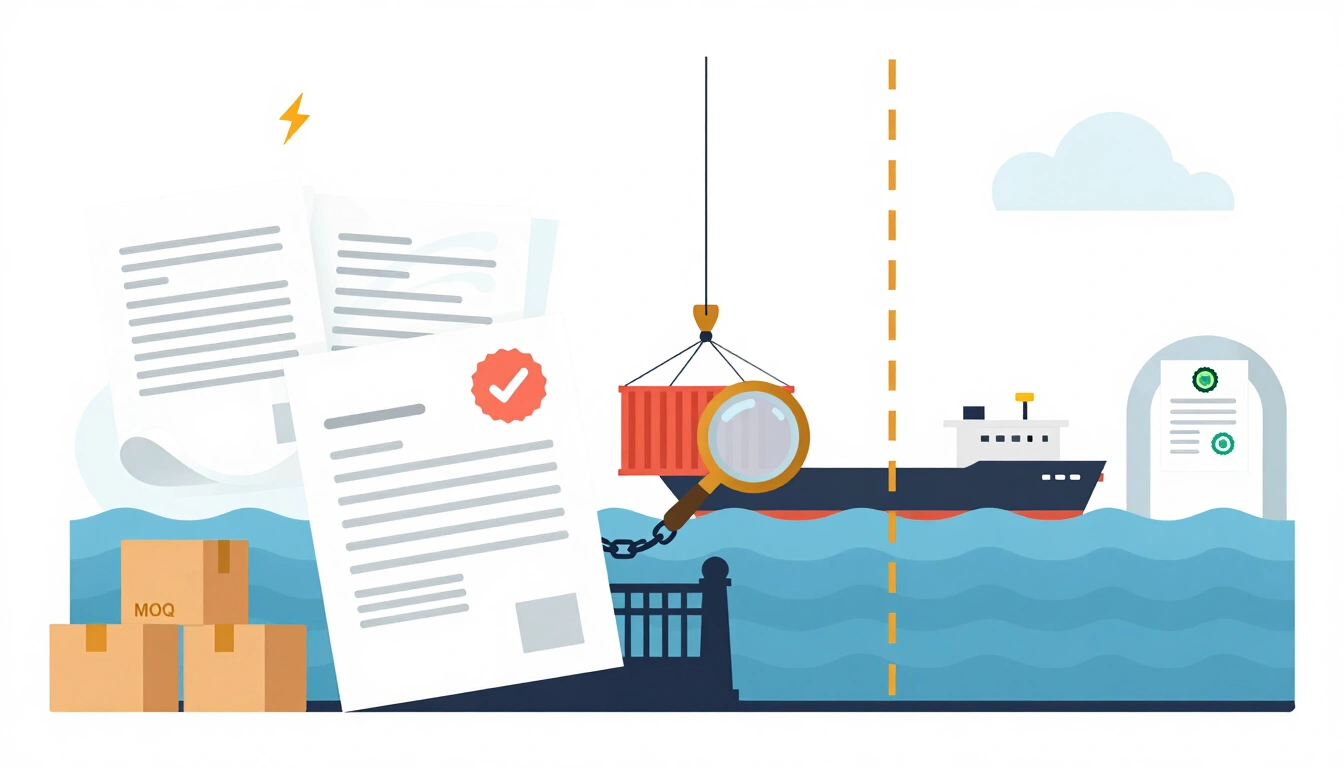
The supplier writes back with a short list: MOQ confirmed, price FOB Shanghai, deposit before production, sample before the batch. Those words all sound normal until the cartons arrive with the wrong consignee name and the carrier will not release them. Most first-time China sourcing problems start at handoff points that nobody defined. The direct answer is to learn a short glossary before money moves: quote fields, Incoterms, payment triggers, sample stages, AQL, shipping documents, and importer-of-record obligations. Each term tells you which cost or which risk is moving from the factory to you.
What the quote really commits you to
A supplier price is rarely a single number. It is a price basis, a quantity break, a packaging note, a lead time, and a payment split. Each field is a handoff. If the quote says FOB Shanghai, you know the factory is responsible until the goods are loaded on board the vessel. You do not yet know whether the price includes the retail cartons, the shrink-wrap, the inspection samples, or the pallet. Usually nobody is hiding anything; the gap is simply paperwork.
Before you treat a quote as a price, push it to answer these fields:
- MOQ (minimum order quantity): does it apply per order, per colorway, or per size?
- Price basis: EXW, FOB, CIF, or DDP, with the named port or city.
- Lead time: does it start from the deposit, from sample approval, or from purchase order receipt?
- Packaging scope: inner pack, outer carton dimensions, carton markings, palletization, and whether the cost is included.
- Payment schedule: deposit amount, balance trigger, and bank details.
- Tooling and one-time fees: molds or setup charges, whether amortized into the unit price or billed separately.
- Quote validity: raw material prices move, so a date keeps the price honest.
Write the answers into a purchase order, not an email thread. A quote with no validity date, no lead-time trigger, and no packaging note is the opening position, not the agreement.
Which Incoterm should you pick?
Incoterms are the trade rules published by the International Chamber of Commerce. They split who pays freight, who bears risk, and where the goods are considered delivered. They do not determine payment terms, ownership, or breach penalties. They also do not settle who files customs declarations unless the chosen term says so. Under FOB, the seller clears export; under DDP, the seller clears import; under EXW, the buyer handles it.
| Term | Supplier covers | You cover | When it fits |
|---|---|---|---|
| EXW (Ex Works) | Goods made available at the factory | Collection, inland freight, export clearance, ocean freight, insurance | When your forwarder already controls local pickup and you want each logistics step priced separately. |
| FOB (franco a bordo) | Export packing, local delivery, export clearance, loading on board the vessel | Ocean freight, insurance, import clearance, duty, inland delivery | The common default: a clean handoff at the export port. |
| CIF (Costo, Seguro, Flete) | Ocean freight and basic insurance to the destination port | Destination charges, customs, duty, inland trucking, extra insurance | When you want a simple quoted freight price, but basic marine cover is not replacement cover. |
| DDP (Entrega con derechos pagados) | Delivery to the agreed destination, including import clearance and duty | Receiving the goods and providing the supplier the shipping details needed | When the supplier is experienced with your import process and prices that compliance risk in. |
For a small importer, FOB is often the least surprising choice. The factory is responsible until the goods are on board, and your forwarder manages the rest. DDP looks easier, but the supplier cost of managing your import compliance is folded into the price.
Payment terms are incentive design
T/T (telegraphic transfer) is the common payment method for China orders: a deposit before production and a balance before shipment. The order of events matters more than the wording. If the balance is due before inspection, the factory has little financial reason to fix what an inspector later finds. If the balance is due after inspection and before the vessel departs, you still have leverage.
When you run production directly, a protective sequence looks like this:
- Sign the purchase order and reference the approved sample.
- Pay the deposit.
- Receive and approve a pre-production sample.
- Arrange inspection before the factory loads the container.
- Release the balance only after the inspection report is acceptable and the shipping documents match the purchase order.
- Agree on how the bill of lading or telex release will be transmitted before the vessel departs.
Letters of credit work for larger repeat orders, but they add bank fees, documentary checks, and deadlines. Escrow and platform payment services reduce upfront exposure, but they are payment rails, not quality programs.
Which sample becomes the standard?
Factories use several sample stages. A pre-production sample is made after the contract and before the batch. An approval sample is the one you sign off on. A shipment sample is pulled from the finished cartons. Inspect against the approval sample, not the shipment sample. If you inspect against the shipment sample, you are judging the goods against themselves.
When you approve a sample, write down what may vary: shade tolerance, thread color, carton printing, pack quantity. Without that tolerance, the factory can reasonably drift and still claim it followed the sample.
Sample fees are a separate negotiation. Some suppliers charge and then refund or deduct the cost on the first order; others do not. Whatever the rule, get it in writing before you pay. A free sample that arrives with the wrong material is not free.
AQL and inspection: what passed means
AQL stands for acceptable quality limit, and it comes from statistical sampling. It does not promise zero defects. It sets how many defects of each class you tolerate in a random sample. The system is only useful after you define the defect classes. Critical defects are unsafe or non-functional. Major defects will annoy the end customer. Minor defects are cosmetic.
Put the AQL class limits in the purchase order. Select the sample randomly, compare the goods with the approved sample, and ask for photographs and measurements. Release the balance after you read the findings, not before. If an order is too small to justify a full inspection, photograph the opening of every carton and compare it to the approved sample before releasing the balance. That is a rough fallback, not an equal substitute.
Shipping terms that decide who controls release
FCL means your goods fill a container; LCL means they share one. LCL reduces freight per unit, but it adds handling, increases damage exposure, and makes delivery times less predictable. Fragile goods can erase the savings in claims.
The commercial invoice, packing list, and bill of lading work as a set. The commercial invoice states seller, buyer, description, and value. The packing list states cartons, weights, and dimensions. The bill of lading is a receipt, evidence of the carriage contract, and often the document required to take delivery at destination. A wrong consignee name or a missing original can hold cargo at the port.
Ask your forwarder how originals are transmitted, whether a telex release is used, and who must endorse the document. Cargo insurance is separate from Incoterms. CIF includes basic marine cover, but basic cover is not replacement value. For a high-value container, add marine cargo insurance through the forwarder and ask for the insured value in writing.
Customs terms that stay on your name
Customs cares about the HS code, the declared value, and the origin of the goods. The HS code determines duty, taxes, and sometimes regulatory checks. The supplier can propose a code, but the legal responsibility for an accurate declaration sits with the importer of record, the party legally responsible for the import declaration, duty payment, and compliance. Verify the code in the destination customs tariff before shipment, not after arrival.
Confirm the importer identification number your customs authority requires before the goods arrive. A shipment arriving in the wrong name can be held or refused. The supplier export documents should match your import paperwork: same consignee, same address, same goods description. Name mismatches create delays and storage charges.
Keep these terms close: certificate of origin, consignee, notified party, and duty drawback. The consignee is the party named to receive the goods. The notified party is the one the carrier contacts when cargo arrives. A certificate of origin is an exporter declaration used to claim preferential duty. Duty drawback lets you recover duties paid on imported materials that are later re-exported. Some products also need certificates or lab testing before shipment, especially electronics, batteries, food-contact materials, and personal care. Confirm with the destination customs authority before you commit to an order.
Contract words that matter when things go wrong
Beyond the quote, review force majeure, warranty, inspection rights, and dispute resolution. A force majeure clause excuses non-performance in exceptional events. The practical question is who must prove the event and what evidence counts. A warranty in a supplier template may only cover replacement parts, not the loss from a failed batch. If you want a refund or a full-batch replacement, the words need to say so.
Dispute resolution matters because a buyer and a factory rarely share a home court. A purchase order can state which country law applies and whether disagreements go to arbitration or litigation. That can be written in a short paragraph without turning into a long contract.
When can you run this directly?
Run direct if your product is stable, your packaging is repeatable, you already work with a forwarder, and you have time to coordinate a sample and an inspection. The terms above cover most routine orders.
Trouble shows up as behavior, not vocabulary: a supplier refuses inspection, the payment schedule changes after a verbal agreement, or the draft bill of lading carries different goods details from the order. Those are red flags before the first container ships.
A sourcing partner can keep supplier vetting and inspection visible. You can review SourcingAll’s workflow to see where an agent fits, and the service page shows what an inspection and logistics handoff includes. You still own the commercial terms: HS code, contract, payment trigger. Pick the Incoterm that matches the handoff, reference the approved sample, set the balance after the inspection report, and confirm who is importer of record. Put those details in writing, and the next batch becomes routine.