
Most first-time importers lose money not because they picked a bad product, but because they skipped one or two verification steps between idea and delivery. That expensive lesson often repeats itself across industries. The sequence of decisions—from refining your concept to clearing customs—determines whether your margin survives. Each phase carries distinct risks, and the order matters: rushing a supplier check after placing a deposit is already too late.
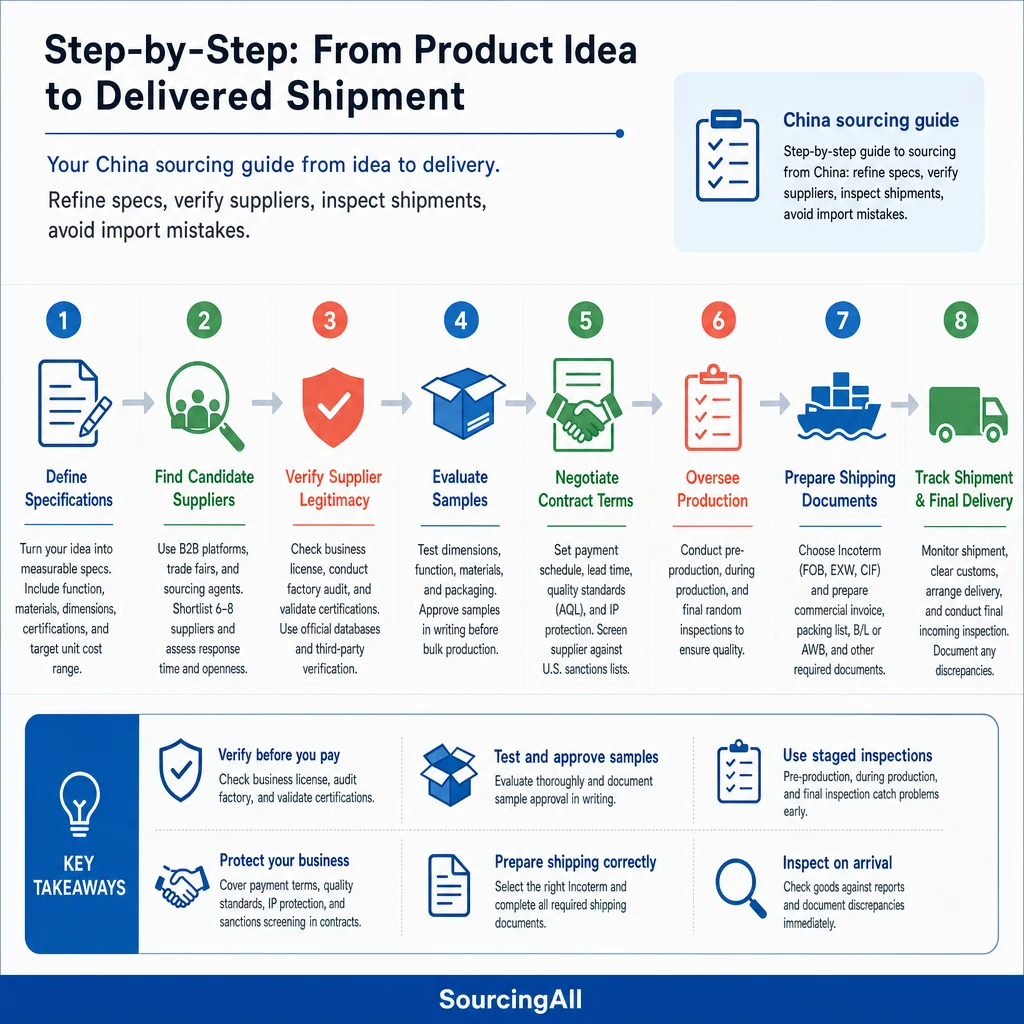
Step 1: Turn Your Product Idea into Measurable Specifications
A vague request like “make a portable charger” invites mismatched proposals. Suppliers will guess at materials, dimensions, and quality, and you’ll pay for those guesses in revision rounds or disappointing samples.
- Core function: Exactly what the product does and the problem it solves.
- Physical dimensions and weight: Maximum allowable size for shipping or retail display.
- Materials and finish: Plastic type (ABS, PC, PP), metal grade, surface coating (matte, glossy, rubberized).
- Required certifications: Electrical safety (CE, FCC, UL), children’s product compliance (CPSIA, EN71), or food-contact approval (FDA, LFGB).
- Target unit cost range: Use a bracket (for example, 2.00–3.50) rather than a fixed number so suppliers can propose realistic materials and processes.
Document this specification in a request for quotation (RFQ) package that includes drawings, CAD files, or photos of a prototype. Clear requirements reduce back-and-forth misinterpretations later.
If you lack design or engineering skills, consider hiring a product development consultant who specializes in Chinese manufacturing. They can translate your verbal idea into factory-ready technical files.
One spec that includes tolerances on critical dimensions will separate serious factories from order-takers who only want a quick signature.
Step 2: Find Candidate Suppliers Using Multiple Channels
Three main channels exist for locating manufacturers in China:
- B2B online platforms – Alibaba, Made-in-China, Global Sources. These aggregate thousands of suppliers, but they mix direct factories with trading companies. A verified supplier badge alone does not guarantee factory ownership.
- Trade fairs – Canton Fair (held in Guangzhou twice a year) plus industry-specific shows in Shanghai, Shenzhen, and Yiwu. Face-to-face meetings allow you to inspect product samples and assess communication skills.
- Sourcing agents – Firms like CJ Dropshipping or specialized China sourcing agents act as intermediaries. According to CJ Dropshipping’s guide, agents cover everything from finding suppliers and negotiating prices to managing production and logistics – especially useful for businesses without a local presence in China.
Regardless of the channel, compile a shortlist of at least six to eight potential suppliers. Narrow it down by checking their response time, willingness to share factory photos, and readiness to discuss specific technical questions. Avoid suppliers who immediately push for an order without answering your specification details.
Step 3: Verify the Supplier’s Legal Status and Factory Capability
Verification is the most important step – and the one most often skipped by eager new importers. A supplier that looks professional online may be a front desk operation renting samples from a real factory.
Three core verification activities:
Business license check – Ask for a copy of the supplier’s Chinese business license. It should include the registered company name, unified social credit code, legal representative, and scope of business. You can cross-check the credit code against China’s official National Enterprise Credit Information Publicity System (operated by the State Administration for Market Regulation). This database – not third-party platforms – is the authoritative registry. Confirm that the license is active and covers the product category you intend to manufacture.
Factory audit – A third-party factory audit verifies actual production capacity, equipment, worker headcount, and quality management systems. As the Connected Sourcing blog explains, supplier verification includes business license checks, factory audits, product certifications, and sample validation. An auditor visits the factory floor, photographs machinery, and interviews management. This eliminates suppliers who outsource your order to an unknown facility.
Certifications validation – If your product requires ISO 9001, BSCI, or a specific product certificate (e.g., CE, RoHS), request a copy of the certificate and verify its validity with the issuing body. Some suppliers present forged certificates. A quick email to the certification agency can confirm whether the factory name appears on their valid list.
Importivity’s blog on supplier vetting notes that a robust process combines a license check, audit, and sample evaluation. Do not rely on a single element. A supplier who resists a third-party audit is likely hiding something.
Step 4: Evaluate Samples Thoroughly Before Committing to Production
After you gain confidence in the supplier’s legitimacy, request samples. For custom (OEM/ODM) products, the supplier will produce first articles from your specification. For stock or modified stock products, request the exact item you intend to sell, not just a similar model.
What to test:
- Physical dimensions – Measure against your spec. Tolerances on critical dimensions may be acceptable for some products, but not for components that must fit together.
- Function and performance – Run the product through its intended use cycle. For an electronic item, test battery life, charging speed, interface responsiveness.
- Material identification – Conduct a simple burn test for plastics or use a third-party lab if material safety is critical (children’s toys, food containers).
- Packaging suitability – Verify that the packaging protects the product, includes required labels (origin, warnings, recycling marks), and matches your brand requirements.
Once the sample passes your criteria, document approval in writing. Do not skip this step and assume bulk production will match. The same supplier may produce samples with more attention than standard production runs. A formal sample approval sheet, signed by both parties, establishes a baseline for later quality inspections.
Suppliers rarely reject the chance to adjust a sample if you catch an issue; they want the order. The unspoken problems are the ones that fester when you don’t look closely. A perfect sample doesn’t guarantee a perfect production run.
Step 5: Negotiate Contract Terms with Payment and Intellectual Property Protection
A simple purchase order is not enough for complex or high-volume orders. At minimum, the contract should cover:
- Payment schedule – Avoid paying the full amount upfront. A common structure is a deposit upon order confirmation and the balance before shipment. Negotiate the split based on the supplier’s track record and your risk tolerance. No fixed percentage is universally correct; it depends on the product and relationship.
- Lead time – Specify the number of days from deposit receipt to completion of production, plus separate shipping time.
- Quality standards – Reference the approved sample and define acceptable quality level (AQL) limits. If you plan to use a third-party inspection, include the right to reject shipment if it fails a predefined AQL.
- Intellectual property – If you are sharing proprietary designs, add a non-disclosure agreement (NDA) and a clause that prevents the supplier from selling your design to third parties. Registering your patents or trademarks in China provides stronger legal protection than contract clauses alone.
Also confirm that the supplier is not on any U.S. sanctions lists. The U.S. Treasury’s Office of Foreign Assets Control (OFAC) maintains lists of restricted entities and jurisdictions. As noted in the OFAC Consolidated Frequently Asked Questions, businesses must ensure they do not engage in prohibited transactions. Screening your supplier’s ultimate beneficial owners can prevent later asset freezes or shipping blocks. This step is essential if you export to or transact through the United States.
Step 6: Oversee Production with Regular Quality Inspections
Once your deposit is sent and production starts, you cannot simply wait for a shipping notice. Manufacturers sometimes substitute cheaper materials or shortcuts when orders are placed from abroad. The only reliable way to confirm quality is through staged inspections.
Three inspection milestones:
| Inspection Stage | When It Happens | What Is Checked | Why It Matters |
|---|---|---|---|
| Pre-production | After material arrival, before manufacturing begins | Raw material grade, labels, packaging components – verify they match the approved sample | Prevents wrong materials from entering production |
| During production (DUPRO) | When production is partially complete | Assembly line output, initial units, workmanship | Allows correction of defects before the whole batch is produced |
| Final random inspection (FRI) | After production is finished, before shipment | Random sample of cartons per AQL standard, testing dimensions, function, packaging | Decides whether to ship, repair, or reject the order |
SourcingAll offers these three inspection levels as part of its quality management process. Each inspection flags issues early, saving rework costs and rushed shipping charges that commonly happen when problems are discovered only at arrival.
If you cannot be present in China, hire an inspection company with on-the-ground auditors. Avoid relying on the supplier’s own inspection personnel, who have an incentive to pass any defect.
Step 7: Prepare Shipping Documents and Choose the Right Incoterm
Before the goods leave the factory, you and the supplier must agree on the shipping terms (Incoterms) and create the documents required by your country’s customs.
Common Incoterms for China imports:
- FOB (Free on Board) – The supplier pays for transportation to the port of loading and loading onto the vessel. You cover the ocean freight, insurance, and destination logistics. This is the most common arrangement for first-time buyers because it gives you control over freight costs.
- EXW (Ex Works) – You assume all responsibility from the factory gate – including inland trucking to the port. EXW can be cheaper but requires you to coordinate each leg.
- CIF (Cost, Insurance, Freight) – The supplier covers shipping and insurance to the destination port. Use CIF when you trust the supplier’s logistics choices, but note that you lose control over carrier selection.
Essential shipping documents:
- Commercial invoice and packing list (with HS code, unit value, and total weight)
- Bill of lading (for ocean) or air waybill (for air)
- Certificate of origin (may reduce duty under free-trade agreements)
- Any import permits required by your destination country (e.g., FDA prior notice for food-contact products entering the U.S.)
The Canadian Food Inspection Agency (CFIA) provides a step-by-step import guide for food products, confirming that imported goods may also require permits from agencies other than customs. Always check your own government’s import requirements before the goods ship.
Step 8: Track Shipment and Prepare for Final Delivery
After the goods depart, obtain the tracking number and vessel name. Use a logistics software or your freight forwarder’s portal to monitor the estimated arrival date. Many forwarders allow you to set alerts for customs clearance status.
When the shipment arrives at destination port, you need to:
- Pay any remaining duties, taxes, and port handling fees.
- Submit the original bill of lading (or telex release) to the shipping line to release the container.
- Arrange drayage from the port to your warehouse or fulfillment center.
Upon receipt, perform a final incoming inspection. Compare the goods against the final inspection report from China. Discrepancies should be documented immediately because cargo insurance and freight claims have strict deadlines.
Each of these steps can be executed entirely on your own or partially outsourced. A DIY approach works if you have experience with Chinese business culture, can travel for audits, and maintain a close relationship with a single supplier. For most small businesses and startups, the risk of a single mistake – such as accepting a counterfeit certificate or skipping a final inspection – outweighs the cost of professional help.
SourcingAll provides dedicated account managers for low-minimum orders, small batch production, and end-to-end quality control coordination. If you want to reduce the time spent on verification and inspections, consider contacting us to discuss your product idea and receive a customized sourcing plan.