
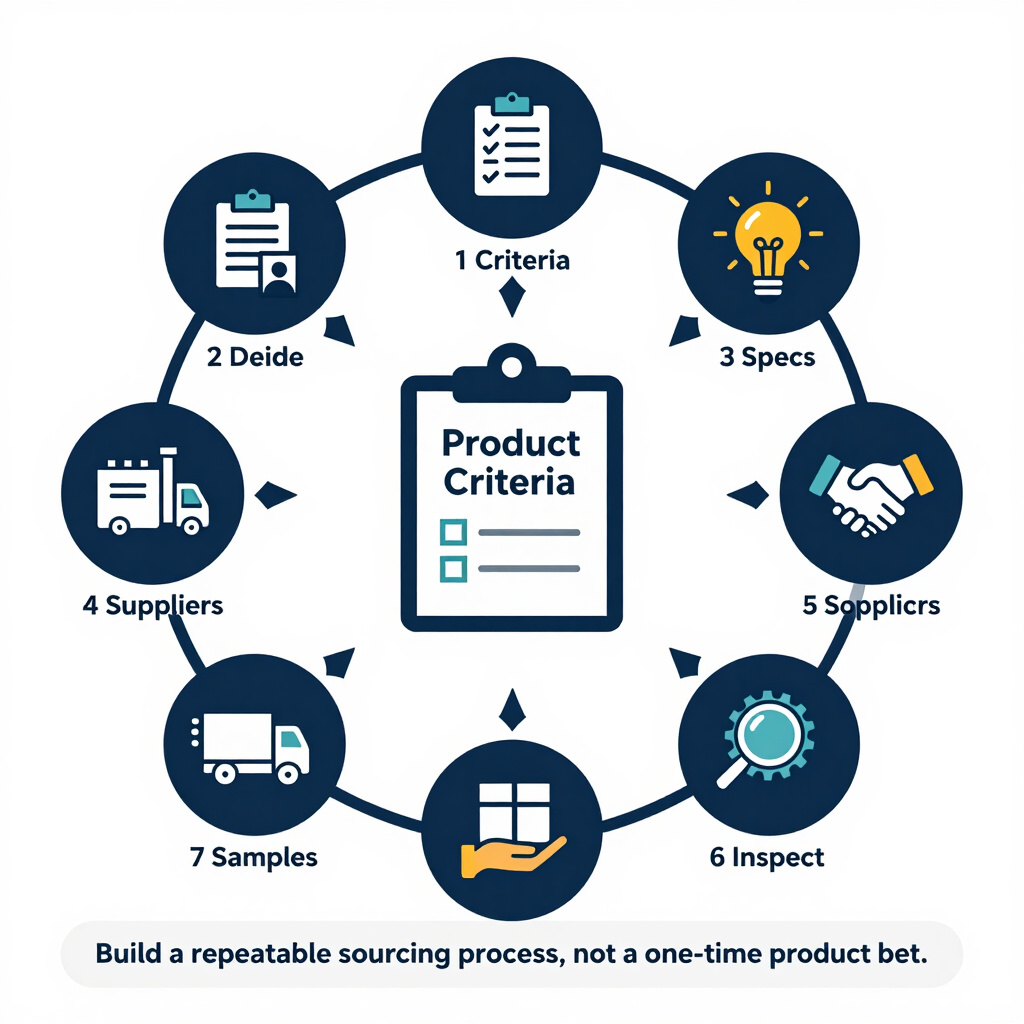
Why sourcing decisions start with a framework, not a product list
You have seen the lists of hot products for 2026. They do not tell you how to get those products made, inspected, and shipped. That gap is where sourcing projects stall.
No responsible advisor can hand you a winning product list without knowing your budget, your customers, and your tolerance for risk. The useful alternative is a repeatable sourcing framework you can apply to your own product ideas. That is what follows. Every product example is hypothetical and labeled as such, not a recommendation.
For illustration only: a light, compact product may be cheap to ship but crowded with competitors; a heavy, fragile product may have better margins but eat those margins in breakage and freight; a seasonal product can generate strong revenue for a few months and then sit in storage. A structured process helps you weigh these trade-offs before you commit money to tooling, samples, or inventory.
For broader background on how sourcing projects are structured, see the Sourcing articles archive.
Step 1: Define your product criteria before you search
You might start by asking what to sell. The more useful first question is what your business can actually support. Write down your constraints before you look at any product idea:
- Budget: how much capital can you commit to samples, tooling, production, and freight without starving other parts of the business?
- Storage: where will inventory sit, and how much space do you have?
- Shipping weight and dimensions: can you store and ship this cost-effectively given your fulfillment setup?
- Fragility: will breakage in transit destroy your margin?
- Seasonality: can you sell this year-round, or do you need to manage a single peak?
- Customer fit: does this solve a problem your existing audience already has?
Record your minimum acceptable margin and maximum acceptable unit cost as internal business decisions. No one else can set these for you. They depend on your price point, your marketing costs, and your cash flow. Assign a weight to each criterion according to your business model. A business with no warehouse may weigh shipping weight and storage differently than a brand with a fulfillment center.
Your criteria become the filter for every product idea you evaluate later. If an idea fails a non-negotiable criterion, it is out, no matter how attractive the market looks.
Here is a scoring checklist you can copy into a spreadsheet:
| Criterion | Question to answer | Peso | Non-negotiable? |
|---|---|---|---|
| Unit cost ceiling | What is the most you can pay per unit and still hit your margin? | ||
| Shipping weight and dimensions | Can you store and ship this cost-effectively? | ||
| Fragility | Will breakage in transit destroy your margin? | ||
| Seasonality | Can you sell this year-round, or do you need a single peak? | ||
| Storage | Where will inventory sit before orders ship? | ||
| Customer fit | Does this solve a problem your audience already has? |
For illustration only, a small outdoor brand might prioritize light weight and compact packaging because they ship directly to hikers. That is a hypothetical example, not a recommendation. The point is that their criteria would look different from a furniture importer’s criteria.
Step 2: Generate and shortlist product ideas using transparent research
Once your criteria are set, build a long list of product concepts from your own research. Consider these sources:
- Customer research: what do your existing customers complain about, ask for, or improvise around?
- Competitor observation: what are competitors selling, and where are the obvious gaps in their offers?
- Keyword exploration: what problems are people searching for that no product currently answers well?
Score each idea against your criteria. Remove ideas that fail a non-negotiable requirement. Then rank the survivors by weighted score. End this step with a shortlist of a few concepts that deserve deeper sourcing evaluation.
To keep this concrete: a pet accessories brand might, for illustration only, look at collapsible water bowls, travel feeders, and grooming kits. Those are hypothetical examples, not recommendations. The scoring process, not the category name, decides which one survives.
Step 3: Turn your shortlist into detailed sourcing requirements
A product concept is not a specification. Write down your requirements so suppliers can respond to the same details you have in mind.
Write down, for each shortlisted concept:
- Dimensions and tolerances
- Materials and finishes
- Colors, with reference numbers where possible
- Requisitos de embalaje y etiquetado
- Functionality and performance benchmarks
- Quality acceptance criteria
- Which components are standard and which require custom tooling
Include drawings, photos, or reference samples where you can.
Here is a specification sheet template:
- Product name and intended use
- Dimensions and tolerances
- Materials and finishes
- Colors and reference numbers
- Requisitos de embalaje y etiquetado
- Functionality and performance benchmarks
- Quality acceptance criteria
- Target unit cost and target production timeline (internal, not shared with suppliers)
- Drawings, photos, or reference samples
Prepare questions about a supplier’s manufacturing capabilities without assuming any specific capabilities exist. Ask what processes they run in-house, what they subcontract, and whether they have made similar products before. Their answers will shape your shortlist in the next step.
Step 4: Find and vet potential suppliers in China
With a written specification in hand, build an initial list of candidate suppliers. You can find candidates through B2B platforms, trade shows, and referral networks. Treat the list as unverified until you screen it.
Screen candidates on:
- Business license and registration details
- Relevant certifications for the product category
- Responsiveness and clarity of communication
- Willingness to arrange an audit or video walkthrough
- References from other buyers
Ask for references and sample batches before making a commitment. Do not judge a supplier by website quality alone. A polished website can hide a trading company, and a plain website can belong to a manufacturer.
This screening process is time-intensive. You may choose to outsource it to a sourcing partner. Sourcing services y How SourcingAll works describe how that kind of engagement is structured. No specific outcome is claimed here; the point is that the work has to happen somewhere.
Step 5: Validate ideas through sampling and product development
Sampling is where a product idea becomes a real product. Request samples from the top shortlisted suppliers and compare them against your specification sheet.
Check functionality, durability, and safety where relevant. Specific regulations are outside the scope of this article, but you are responsible for confirming that your product meets the requirements of the markets where you sell.
Expect an iterative cycle: review the sample, list what does not match your specification, send the list back, and request a revised sample. Repeat until the product matches your requirements. For illustration only, a startup might go through several rounds of custom water bottle samples before approving one. That is a hypothetical example, not a claim about typical outcomes.
Sample coordination can be done in-house or with a partner. If you want to see how a structured sample coordination process works, the How SourcingAll works page explains the steps.
Step 6: Monitor production and conduct quality inspection
Once a sample is approved, agree on a production timeline, quality standards, and inspection milestones before mass production begins. Do not let production start without those agreements in writing.
Use progress updates and inspection checkpoints to catch defects early.
Inspect finished goods before shipment to confirm they match the approved sample and specification. This is the last point where you can reject non-conforming goods before they are shipped. Production monitoring and quality inspection are services SourcingAll offers, but no success rates are claimed here.
Step 7: Plan logistics from factory to customer
Logistics planning should start before production finishes, not after. Decide whether the supplier or a freight forwarder will handle shipping and customs clearance. Compare delivery methods by cost and time, without assuming one is always better. The right choice depends on your product’s weight, value, and how quickly you need it.
Plan warehousing, fulfillment, and returns before the shipment arrives. If you have nowhere to put the goods, a fast shipment can create a storage bill. Track shipment milestones and keep all documentation organized: commercial invoice, packing list, bill of lading, and any certificates the product requires.
Logistics coordination is one of SourcingAll’s services, but no shipping claims are made here.
Step 8: Choose between managing sourcing yourself and using a sourcing partner
In-house sourcing gives you direct control over every decision, but it requires time, travel, and sustained communication effort across time zones. If you are a solo founder, that time competes with marketing, customer service, and product development.
A sourcing partner can handle supplier search, vetting, sampling, production monitoring, inspection, and logistics coordination. The trade-off is cost and a layer of indirection between you and the factory.
The right choice depends on team capacity, product complexity, and budget. This article does not make a blanket recommendation. If your product is simple and you have time, managing it yourself is reasonable. If your product has many components, strict quality requirements, or a tight launch date, a partner may be worth the cost.
Readers who want help can Get a quote or read How SourcingAll works to understand the engagement model before deciding.
Conclusion: Build a repeatable sourcing process, not a one-time product bet
This article does not claim to know the best product to source in 2026. The right product should come from your own scoring process, applied honestly to your own constraints.
The value of the framework is that it is repeatable. The first product you source can teach you things about your criteria, your specification, and your suppliers. Reapplying the same framework for each new product builds long-term sourcing capability.
If you want to see how sourcing projects can be structured, the Case studies page is a starting point. The Preguntas frecuentes answer common questions about working with a sourcing partner, and About SourcingAll explains the company behind the services. When you are ready to put the framework into practice, Contact SourcingAll o Get a quote to start the conversation.