
Imagine this: you send a detailed inquiry to a factory in Shenzhen. You include product specs, target quantity, and a requested timeline. You wait three days and hear nothing. Meanwhile, a competitor who orders twice the volume gets a reply within hoursand a production slot that matches their schedule. This is a hypothetical scenario, but it captures the frustration many small buyers feel. The real question is what drives their decisions about which orders to schedule first, which buyers to answer quickly, and which relationships to protect.
Setting the frame
What makes factories prioritize your orders? In short, factories prioritize orders that fit their capacity, create less scheduling risk, and come from buyers who are easy to plan around. That decision comes from operational constraints, risk perception, and the signals you send through every interaction. The factors below are practical, and the framework applies to your own sourcing behavior. Any examples are clearly labeled as hypothetical and are meant to illustrate a point, not to predict your results.
Inside the factory: capacity, scheduling, and risk perception
Factories run on capacity. They have a fixed number of machines, workers, and hours per week. When orders come in, someone has to decide which ones run first. Order size matters, but so does risk.
Consider what a factory sees when it looks at your purchase order. Is the specification clear enough to start production without back-and-forth? Are the payment terms structured so the factory can buy materials without tying up too much cash? Is the production complexity something the line can handle without disrupting other orders? Does the buyer have a history of accepting shipments without unreasonable delays? These are qualitative factors, not measured findings. They form a mental model of how factories think about scheduling.
For example, a hypothetical buyer sends a purchase order with vague color codesand no reference sample. The factory must pause production to ask for clarification. That pause costs timeand creates uncertainty. Another buyer sends a complete spec pack with Pantone numbers, material swatches, anda signed quality agreement. The factory can plan immediately. You can guess which order gets the earlier slot. The second buyer is not bigger. The second buyer is easier to plan around.
Order signals you control: a comparison for small buyers
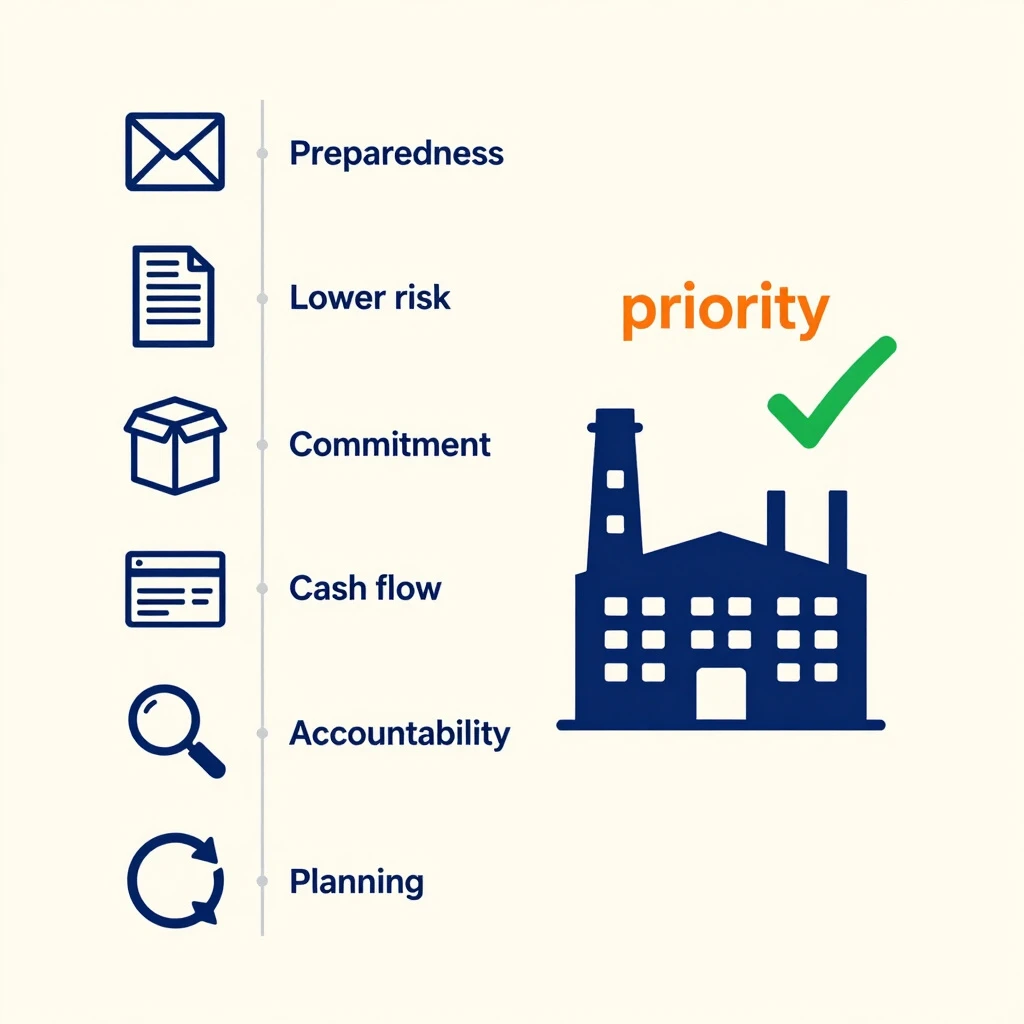
You cannot control your order volume overnight, but you can control the signals you send. The table below shows six signalsanda possible factory perception. This is a descriptive framework only; outcomes vary by factory, order type, and market conditions.
| Signal | Possible Factory Perception |
|---|---|
| Inquiry structure | Preparedness and clarity |
| Order specifications | Lower miscommunication risk |
| Sample process | Serious commitment to the product |
| Condiciones de pago | Cash-flow predictability |
| Inspection follow-through | Accountabilityand quality focus |
| Order consistency | Long-term planning potential |
Each of these signals is within your control, even on a first order. A complete inquiry tells the factory you have done your homework. Clear specifications can reduce the chance of a costly mistake. A serious sample process can show you are not just price-shopping. Payment terms that are easy to understand can help the factory plan cash flow. Inspection follow-through can signal that you will not accept defects silently. Order consistency, even when the orders are small, can suggest you might become a repeat customer. None of these guarantee priority. They reduce the friction that makes a factory hesitant to slot you in.
Build supplier loyalty: a step-by-step framework for small brands
Supplier loyalty builds through a sequence of behaviors, not a single gesture. Here is a chronological framework you can follow from first inquiry to repeat order. All examples are hypothetical. Following these steps does not guarantee priority.
- Send a complete inquiry. Include product specifications, target quantity, desired timeline, and any relevant certifications or packaging requirements. A vague inquiry forces the factory to ask questions, which delays your responseandsignals that you may be a difficult buyer.
- Treat sampling as a two-way conversation. When you receive a sample, test it against your requirements. Ask the factory about material sourcing, production tolerances,andlead times. Document the answers. This shows you are serious about the product, not just fishing for a low price.
- Issue a clear purchase order. Your PO should state delivery dates, inspection criteria, and any penalties for late delivery. A well-written PO reduces ambiguityand gives the factory a concrete plan to work from.
- Align payment terms early. Do not wait until the last minute to negotiate payment. Discuss deposit percentages, balance payment triggers, and whether you can offer a letter of credit or a faster payment schedule. Predictable cash flow is valuable to a factory.
- Conduct structured follow-ups. During production, agree on an update cadence. After delivery, share feedback on product qualityand packaging. If you plan to reorder, say so. That gives the factory a reason to keep you in mind for future capacity.
In this framework, a complete inquiry leads to a better sample. A better sample leads to a clearer PO. A clearer PO makes payment terms easier to discuss. Structured follow-ups turn a one-off transaction into a relationship.
Communication routines that keep you easy to work with
Communication is about being predictable more than being friendly. Factories juggle multiple buyers. The ones who are easy to work with get more attention. Here are routines that reinforce that perception.
Establish one primary channel. Whether it is WeChat, email, or a project management tool, use the same channel consistently. Do not switch between platforms mid-project. This reduces the chance of missed messagesand makes it easier for the factory to find your history.
Put decisions in writing. After a call or video meeting, send a summary of what was agreed. This protects both sidesand prevents misunderstandings. For example, a hypothetical buyer agrees to a change in packaging during a call but does not confirm it in writing. The factory proceeds with the original packaging, and the buyer is upset. A written summary would have avoided that.
Give feedback that is specificand solution-oriented. Instead of saying “the quality is bad,” say “the stitching on the left sleeve is loose; can you adjust the tension on the machine?” This helps the factory fix the issue quicklyand shows you understand production.
Avoid false urgency. If you constantly mark every email as urgent, the factory will learn to ignore your urgency. Save urgent requests for genuine problems. Repeated changes to specifications or timelines make planning harder for the factoryanderode trust.
Supplier loyalty checklist: before, during, and after production
Use this checklist to structure your conversations with the factory. It is a practical tool, not a promise of results.
Supplier communication checklist: before, during,and after production
- Confirm all product specifications before sending a purchase order
- State your target timelineand ask the factory for its suggested schedule
- Clarify payment termsand sample policy in writing
- Agreeon inspection pointsand defect thresholds in advance
- Follow up after delivery with clear feedback for the next order
Before production, the goal is to eliminate ambiguity. During production, stay informed without micromanaging. After production, close the loop so the factory knows what workedand what did not. Repeated over multiple orders, this cycle builds loyalty.
When a sourcing partner strengthens supplier relationships
As a small buyer, you may not have someone on the ground in China. That is a real limitation. You cannot walk the factory floor, check a production line, or resolve a quality issue in person. A sourcing partner can act as your operational bridge.
SourcingAll offers supplier searchand vetting, sample coordination, product development, production monitoring, quality inspection, and logistics coordination. These are capabilities, not guarantees. The value is in having a dedicated person who understands factory operationsand can communicate your requirements clearly. They can help you structure inquiries, coordinate samples, and monitor production so that your behavior signals reliability even when you are not physically present.
If you are considering this route, look at how we work to understand the process. You can also review our sourcing services to see which parts of the workflow you might want to delegate. The goal is not to replace your relationship with the factory, but to make that relationship more consistent.
Frequently asked questions about factory prioritization
Can small buyers compete with larger-volume customers?
Yes, but not by pretending to be bigger than you are. Instead, compete on clarity and ease. A hypothetical small buyer who sends a complete spec pack, offers a straightforward payment structure, and commits to a steady schedule can be more attractive than a large buyer who is disorganized. Factories value predictability, and small buyers can offer that.
Do factories always prioritize biggest orders?
No. Prioritization varies by factory, market conditions, and internal scheduling. A factory may prioritize a small order if it fills a gap in capacity, uses a specific material that is already in stock, or comes from a buyer with a history of on-time payments. The biggest order is not always the most profitable orthe easiest to execute.
What if I have a small first order?
Position it as a proof of a longer relationship. Be explicitthat you are testing the factory for a potential series of orders. This is a hypothetical tactic, not a guarantee. A factory may be more willing to accommodate a small first order if it sees potential for repeat business. You can also ask if the first order can be treated as a pilot or sample run.
For more answers to common sourcing questions, see our sourcing FAQs.
Build supplier loyalty with consistent sourcing behaviors
Supplier loyalty is not built by promises or by hoping the factory likes you. It is built through repeatable sourcing behaviors that reduce riskand make the factory’s life easier. You control the signals you send, the clarity of your documents, and the consistency of your follow-ups. Those are the levers you have, regardless of your order size.
If you want to strengthen your supplier relationships but cannot be on the factory floor, consider working with a partner who can. Get a quote to discuss your specific situation. You can also contact us directly. If you are exploring other sourcing topics, browse our related sourcing articles for more practical guidance.