
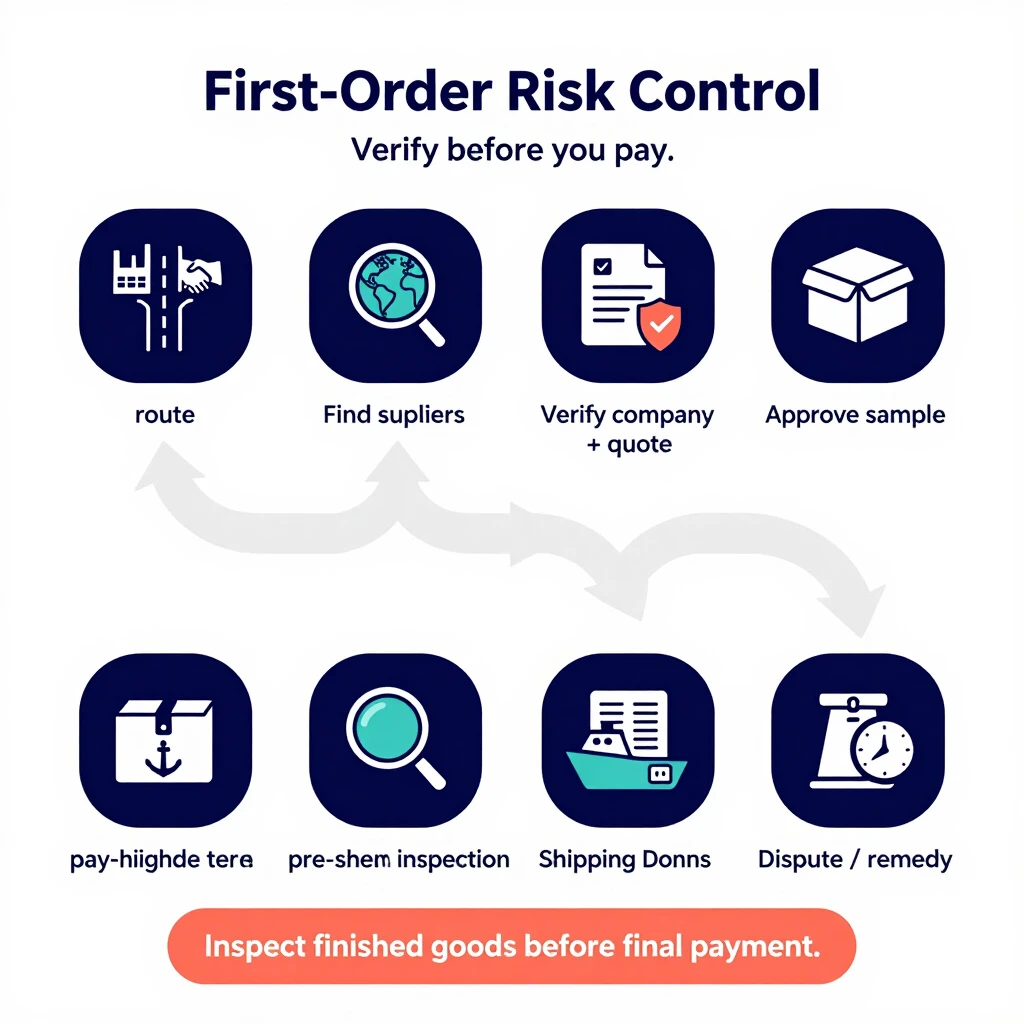
Suppose you have found a product to sell in North America or Europe, a supplier on a B2B marketplace with a responsive contact, a minimum order quantity you can meet, and a price that fits your launch plan. The next step is not placing the order. It is deciding how you will source that order and what happens if the goods are late or defective. For a first-time buyer sourcing from China, keep the sequence tight: choose your route, find candidates, verify the company and the quote, approve a sample in writing, and inspect finished goods before the final payment. None of this replaces legal, customs, or compliance advice, so confirm the product rules for your destination market before you pay.
1. Which sourcing route fits your first order?
| Route | What you are buying | Why a beginner picks it | Where it can go wrong |
|---|---|---|---|
| Direct factory | Manufacturer that makes the product | Can be lower unit price and direct control over production | Hard to verify remotely; language and distance slow down problem solving |
| Trading company | Intermediary reseller | Can handle small orders and several product categories | You pay a margin and may not know the real factory |
| Sourcing agent | Professional coordinator on your side | Checks the company, coordinates samples, monitors production, inspects goods, and helps with logistics | Adds a service cost; you still own the product decisions |
Direct factory buying looks cheapest on paper, but a storefront photo and a chat window do not tell you whether you are dealing with the real manufacturer, a reseller, or a marketing front. A trading company can offer flexibility and communication support, yet you still need to know which factory actually produces the goods. A sourcing agent sits on your side and keeps the milestones in order: verification, sample sign-off, production monitoring, inspection, and logistics. The route you choose changes which documents, payment terms, and checkpoints you need. To see the milestone sequence in detail, read the how we work page.
2. Where do you find suppliers worth contacting?
A practical starting point is a B2B marketplace such as Alibaba, Made-in-China.com, or Global Sources. Industry trade shows and product-specific exhibitions can also work. Treat these channels as lead lists, not proof of reliability. A storefront with years on the platform still needs verification before money moves. Many listings are run by trading companies, which is fine when the trading company is professional and honest. The problem appears when you think you are buying from the factory and you are actually paying a reseller to coordinate with an unknown factory.
Send the same specification sheet to at least three suppliers and compare the answers line by line. If one supplier is much cheaper than the others, ask why and expect a specific answer about materials, tooling, labor, or packaging. A supplier who cannot explain a price gap probably cannot explain a defect later.
3. What should a beginner’s RFQ and quote include?
A useful request for quotation is a written product specification, not a short message asking for a price. Include materials, dimensions, color, function, target quantity, packaging, labeling, barcode and carton requirements, destination country, compliance requirements, and target date. Do not lead with your budget. If you put a target price in your first message, the supplier can quote to that number and adjust the quality to match it.
A comparable quote should state unit price, MOQ, tooling, packaging, sample cost, testing, payment terms, Incoterms rule, lead time, and currency. If a cost is not listed, it still exists somewhere. It will appear later as a separate charge or it will be hidden inside a lower-quality component. Review these line items with the seller before comparing suppliers.
Here is a hypothetical example. Supplier A and Supplier B quote the same unit price. Supplier A states that tooling and packaging are included. Supplier B lists them only as separate charges in a follow-up email after you confirm. The two prices are not equal. Supplier A may still be the wrong choice, but at least the comparison is honest. Ask every supplier to confirm the total cost to your door, including tooling, packaging, samples, testing, and freight.
MOQ is not just a minimum number. It is a cost signal. A high minimum order quantity often points to a production line built around large runs. A low MOQ often points to flexible or manual production. Ask what the unit price becomes at half and at double the minimum. A supplier who cannot explain the difference may not understand your product or their own cost structure.
4. How do you verify a supplier before sending money?
Before any payment, request the business license. Compare the Chinese legal name on the license with the English name used in emails, invoices, and contracts. If the names do not match, you do not know whom you are paying. Confirm the business address and the factory address. If they are different, ask which location actually produces your order.
A live video walkthrough is more convincing than photos. Ask the supplier to walk through the workshop with a phone while showing the equipment and materials that will make your product. Platform badges and transaction counts are marketing signals, not company verification. Ask for recent export records and, if the supplier is willing to share one, a sample export packing list and commercial invoice with customer details removed.
Keep every verification document in the same folder as the quotes and purchase order. If a dispute happens later, this paper trail is the first thing you will need.
5. What should samples prove before you approve production?
Do not approve a sample because it looks right in a photo. Test it the way your customer will use it. Check the material or composition against the specification, measure dimensions and weight, verify colors and print alignment, test the function more than once, and confirm that labels, warnings, and markings are correct for your destination market. Then inspect the packaging and carton markings, because packaging defects create returns and cancellations before the product is even touched.
- Material or composition matches the specification
- Dimensions and weight are within tolerance
- Colors and print alignment match the approved artwork
- Function works repeatedly under realistic use
- Labels, warnings, and country of origin markings are correct
- Packaging, inserts, and carton markings match the purchase order
Approve the sample in writing and reference the approved sample and approval date in the purchase order. If the supplier changes material, color, tooling, or packaging after approval, treat that change as a new sample request, not a production shortcut. Ask about sample cost at the start. Some suppliers deduct the sample fee from the first order, some do not. Do not assume; write the answer into the quote.
6. Which payment terms and Incoterms protect a first-time importer?
Your payment structure is your main lever. A bank transfer is simple and cheap, but once sent, you have no protection. A small initial deposit may be realistic for a serious supplier, but the balance should be tied to inspection results, not to a production update. Some B2B platforms offer payment protection programs; in practice they create an order record and a dispute channel, but they do not verify the goods or guarantee quality. A letter of credit can be secure but is often slow and expensive for a small first order. Payment against documents is another option; in practice it means payment is triggered by the shipping documents, so you usually pay before you see and touch the goods. Confirm the exact terms with your bank.
| Payment option | What it protects | Where it leaves you exposed |
|---|---|---|
| Bank transfer direct to the supplier | Nothing beyond the paper trail | Your money moves before goods exist |
| Deposit plus balance tied to inspection | Aligns payment with verified milestones | The deposit is at risk if production fails |
| Platform payment protection | Creates an order record and a dispute channel | Does not control quality or logistics |
| Letter of credit | Bank involvement in documents and payment | Slow, expensive, and document-sensitive for a small order |
| Payment against documents | Payment is tied to presentation of shipping documents | You usually pay before the goods are in hand |
Use the same Incoterms rule in the quote, purchase order, contract, and freight quote. As a rough summary, EXW usually means the buyer arranges collection and export, FOB usually means the seller delivers the goods onto the ship at the named port, and DDP usually means the seller handles delivery and duty to your destination. These are approximations, not legal definitions. Verify the exact obligations in the current Incoterms 2020 rules published by the International Chamber of Commerce, and confirm the rule with your freight forwarder or customs broker. The common beginner mistake is to quote FOB from the factory and then assume the supplier is responsible for delivery to your door.
7. What should a pre-shipment inspection cover?
Do not let the packing list be the only quality check. A pre-shipment inspection should happen after production is finished and before the goods leave the factory. Use a written checklist and a third-party inspector or your agent. The report should include quantities, random samples from different cartons, appearance and workmanship, dimensions, function, labels, packaging, and carton condition. Set the sample size and acceptable quality level in the purchase order before production starts, not on the day of inspection.
If the first inspection fails, request rework and re-inspection before you release final payment. A failed inspection is not the end of the relationship; it is information. The question is whether the supplier can fix the issues on a clear timeline. Keep all photos, the inspection report, and the email exchange. They become your evidence in a refund or replacement discussion.
If you cannot be on site, an agent can run production monitoring and quality inspection as part of the order. The SourcingAll service page explains how production checks and inspection can be coordinated remotely.
8. Which documents will your first shipment need?
What your first shipment needs depends on the product, destination country, and transport route. For a typical first ocean shipment, expect to prepare a commercial invoice, packing list, and bill of lading. Depending on the destination, a certificate of origin may also be required. Confirm the actual document requirements for your route with your customs broker or freight forwarder.
Product category can add further requirements. Check safety, labeling, registration, and testing rules with the relevant regulator in your destination market before shipping. Your customs broker can handle the entry and duty payment, but you should confirm who is listed as importer of record and what responsibilities come with that role. Determine your HS code, duty rate, tax obligations, and any license requirements before you ship. The guidance here is practical, not legal, customs, or compliance advice.
9. What do you do if the order arrives late or defective?
Prevention is cheaper than recovery. Your purchase order should include remedy terms: what the supplier will do if the goods are late, defective, or different from the approved sample. Rework, replacement, refund, and a quality deposit are all workable remedies if they are written down. The supplier cannot be expected to repair a defect you never defined.
Recovery starts with the paper trail. Compare the shipment to the approved sample, inspection report, photos, and email trail. Then ask the supplier for a corrective action plan with a timeline. If the supplier refuses, use the platform dispute channel if you paid through one, then bring in your agent or a mediator. Cross-border legal action is possible but slower and more expensive than the order itself. The paper trail you built during verification, sampling, and inspection is what makes a dispute manageable.
10. When can you skip an agent, and when is one worth the cost?
Direct sourcing is reasonable when the product is simple, the order value is something you can absorb, the supplier is verified, and you expect to repeat the same order. In that case, your job is to keep the specification and inspection routine consistent. A sourcing agent is worth considering when the product is complex, order value is high, compliance and labeling matter, shipping must be monitored, or you cannot visit the factory easily. The cost of an agent is a business decision, not a failure on your part.
An agent compresses the learning curve because it forces milestones: verification, sample sign-off, production monitoring, pre-shipment inspection, and logistics handoff. The how we work page shows that sequence, and the articles section covers supplier verification and shipping in more depth. If you have questions about timelines, costs, or coverage, the FAQ page may answer them before you commit.
If you have a concrete product idea and you want someone to pressure-test the supplier route, quote, or inspection plan, request a quote for the evaluation. Send your product type, target quantity, and destination market. If you would rather ask questions first, contact SourcingAll with the product details you already have.