
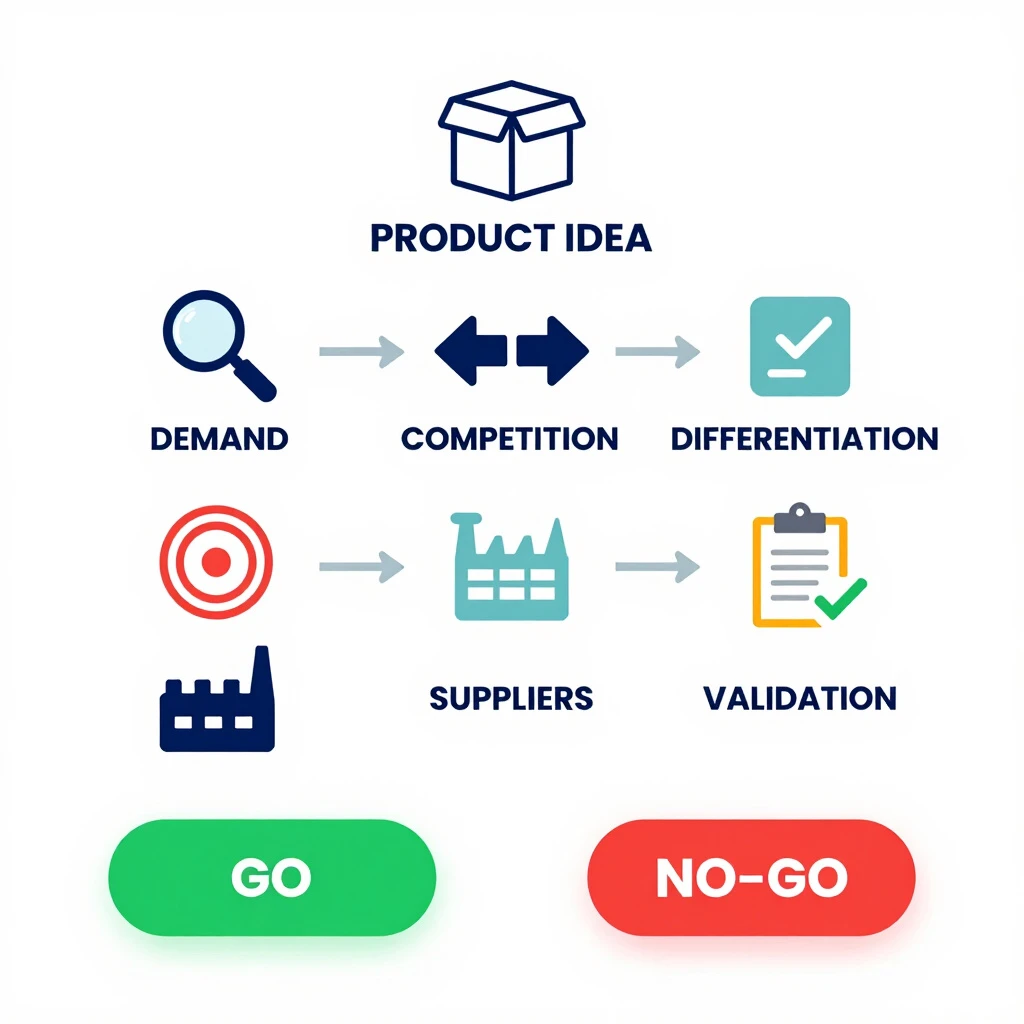
You have a product idea, and you have seen it selling on marketplaces. You are ready to contact suppliers in China. Before you send that inquiry, check whether the market is already crowded. A product market is saturated when the number of sellers offering comparable products has outgrown the pool of buyers who are actively looking. You can spot this before sourcing by checking demand, the competitive landscape, barriers to entry, the supplier landscape, and whether a small batch can be validated. If you cannot name a customer segment that is underserved and you cannot show evidence that people will pay for your version, treat the market as saturated. Work through each check before you commit to sourcing.
What is a saturated product market and why it matters before sourcing
Start with a working definition. In a saturated product market, supply has caught up with demand, and a new entrant has to fight for visibility against sellers who already have reviews, pricing power, or brand recognition. That does not mean the product is bad. It means the cost of acquiring a customer is likely to be higher than your margin can support, especially if you are sourcing a generic version of something already stocked by many sellers.
The point of a pre-sourcing check is to avoid committing money to a product that may not sell well, not to talk yourself out of an idea. It is to decide whether you can enter with a clear advantage. The checklist below will help you compare options and be explicit about what you are assuming.
Step 1: Gauge real demand for your product idea
Begin with demand, because without demand nothing else matters. Look for consistent search interest, not a temporary spike. Search volume trends, social media engagement, and review counts on major ecommerce platforms all give you a rough read. The question is whether interest is genuine and sustained.
Consider this hypothetical. Suppose you search for a product and find many reviews on a major platform. That might indicate strong demand, but it could also signal high competition. Ask whether high demand is accompanied by high supply. If it is, you may need a clear differentiation angle or a specific sub-niche.
Record what you find: search volume ranges, review counts, and engagement levels. This becomes your baseline for later comparison.
Step 2: Map the competitive landscape
Next, map who you are up against. Count direct competitors across major ecommerce platforms and marketplaces. Assess their strength by looking at brand recognition, pricing, review volume, and marketing presence. Then ask whether the market has a few dominant players or many mid-sized sellers.
Watch for price wars, heavy advertising, or a race to the bottom on shipping times. If many sellers offer nearly identical products at similar prices, that may be a red flag. In a hypothetical scenario, you might find that the top listings for a product all use the same supplier photos and have similar price points. That could indicate a crowded market with minimal differentiation.
Review distribution also matters. If top sellers have many reviews and new entrants have few, gaining visibility may be challenging. That does not mean you should abandon the idea. It means you need a stronger angle or a different customer segment.
Step 3: Evaluate barriers to entry and differentiation opportunities
Now look at what it takes to enter. Product complexity and capital requirements can affect your timeline and budget. Treat those as part of the entry decision.
Look for gaps in customer needs that competitors are not addressing. A gap can be a design improvement, a bundle, a niche targeting a specific user group, or a better customer experience. Ask yourself: What can I offer that the current market does not? Is that difference sustainable, or can competitors copy it quickly?
A hypothetical example: a generic kitchen gadget could be differentiated by targeting left-handed users, adding a measurement scale, or bundling it with a recipe book. The key is to find a specific pain point that existing sellers ignore.
Step 4: Check the supplier landscape
Suppliers can tell you a lot about saturation. Check how many suppliers offer the product, their minimum order quantities, and how responsive they are. Ask whether they are willing to discuss modifications, quality control, and lead times.
If every supplier you contact gives you the same generic response and the same MOQ, that may indicate the product is commoditized. If suppliers are flexible and willing to work with your specs, you have more room to differentiate.
This is also where a sourcing partner earns its fee. SourcingAll offers supplier search and vetting services to help you find reliable manufacturers.
Step 5: Run a small-scale validation (samples and pre-orders)
Before mass production, test the market with a small investment. Order samples to evaluate quality and feasibility. Use those samples to gather feedback from a small audience or through pre-orders. The goal is not to make a profit. It is to confirm that people will actually pay for your version of the product.
Consider whether you can get a few customers to commit before you place a large order. This can provide valuable feedback on design, packaging, and pricing. If you cannot get pre-orders, that is information.
SourcingAll offers sample coordination and product development support to help you manage this phase.
Common mistakes when judging market saturation
A common mistake is relying on gut feeling. You might love a product and assume others will too, but the data may say otherwise. You might also underestimate competition. A few big sellers could dominate a market even if the total number of sellers is low.
Another common mistake is mistaking high demand for an opportunity. High demand without considering supply can lead you into a crowded field. Skipping validation and going straight to mass production is another. That could result in inventory you cannot move. Finally, failing to consider differentiation or niche opportunities means entering the same way everyone else did, with no reason for a buyer to choose you.
A go/no-go decision rubric for your product idea
Use this checklist to make the assessment concrete. Score each factor honestly.
| Factor | What to evaluate |
|---|---|
| Demand | Is there consistent, verifiable search and purchase interest? |
| Competition | How many strong competitors exist, and how intense is price pressure? |
| Differentiation | Can you offer a unique angle that is sustainable? |
| Supplier ease | Are suppliers responsive, flexible, and willing to work with your specs? |
| Validation results | Did samples and pre-orders show real interest and positive feedback? |
This checklist is a decision aid, not a guarantee. It forces you to be explicit about your assumptions and gives you a structured way to compare different product ideas.
When you need a sourcing partner
Once a product passes your evaluation, you need a sourcing partner who can execute. SourcingAll offers supplier search and vetting, sample coordination and product development, and production monitoring, quality inspection, and logistics coordination for international buyers.
You can learn more about who they are y how they have helped other buyers. If you have a product idea, request a quote o contact the team.
Run the checklist on your current product idea before you commit to a production run. It covers demand, competition, barriers to entry, supplier responsiveness, and validation results. Use it to make a clear go/no-go decision. If the idea passes, move forward with confidence. If it does not, look for a different angle or a new niche. Spotting a saturated market is about discipline, not luck. When you are ready to source, get a quote from SourcingAll.