
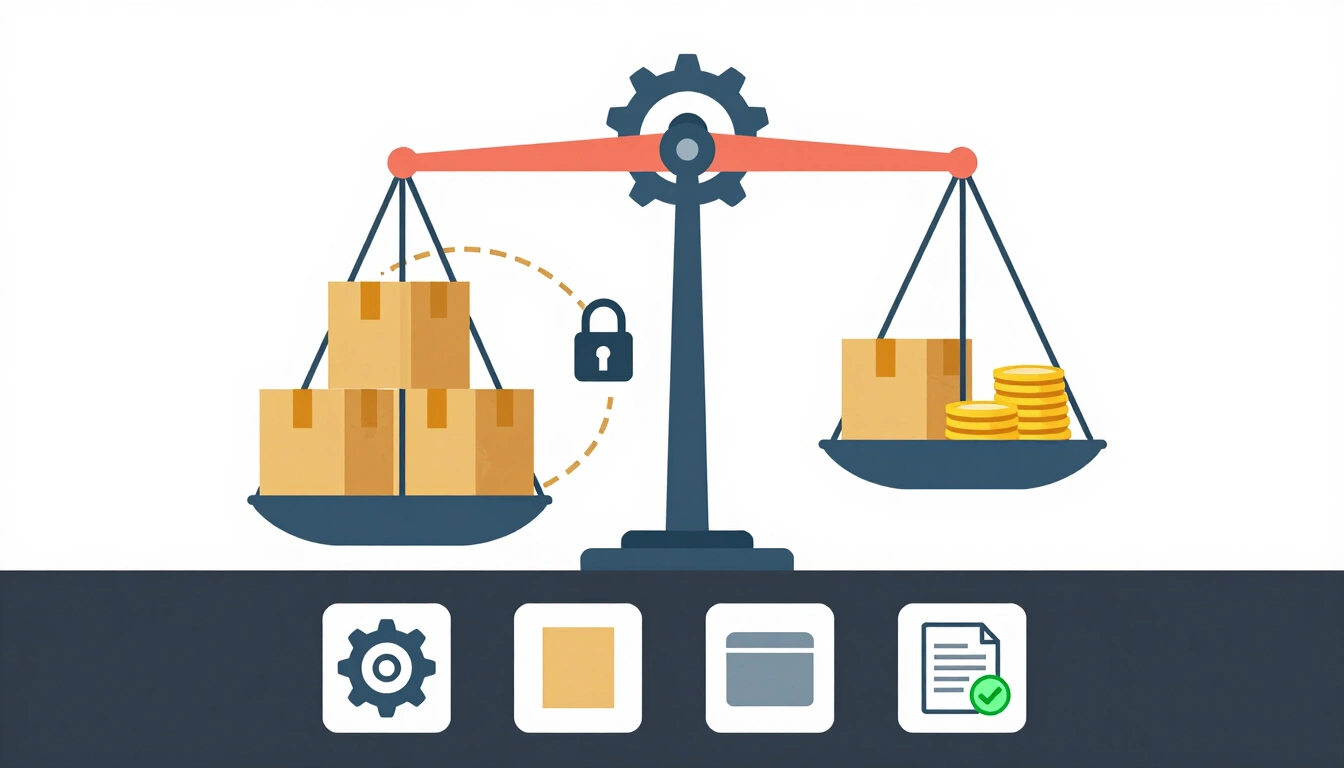
Say you finally found a factory that can make the product right. The samples passed, the price is close, and then you hit the line on the quote that reads MOQ, a minimum quantity you can’t sell before the season turns, can’t store, and can’t finance. The natural move is to walk. Before you do, read that number for what it is. An MOQ is the smallest batch a supplier will produce or ship for you, and it exists because the supplier carries fixed costs, materials, tooling, line setup, labor, packaging, inspection, that only make sense when spread across enough units. That math is the supplier’s own calculation, not a legal floor and not a fixed marketplace rule. You negotiate a lower MOQ by attacking the cost structure behind it, not by haggling over the number itself.
What an MOQ actually is, and what it isn’t
Most quote sheets state the MOQ as pieces or cartons. Some state it as a minimum order value, a currency floor. That usually signals a product where the real cost sits in order processing, packing, and shipping rather than in the parts, so the supplier may accept expensive few-piece orders as easily as cheap volume. On platforms such as Alibaba, the MOQ is a standard field on supplier listings, and new buyers often mistake it for an immutable setting. It isn’t, it’s a business term the supplier sets and can change.
Several details get new buyers into trouble. The MOQ may be quoted per variant: a minimum per color, per size, or per configuration. A quote that shows a moderate minimum per SKU multiplies in practice as soon as you select several colors and sizes. The production MOQ is also separate from the sample MOQ, samples carry their own, far smaller threshold, and confusing the two leads you to over-order samples or under-order the pilot run. And the effective floor may be packing-based: many factories think in cartons, so the practical minimum can be a single inner pack or a single carton even when the printed MOQ looks larger.
Also confirm whether the MOQ is per production run or per shipment. Some suppliers will produce a full batch and release it in stages; your first payment and first arrival shrink without the factory lowering its stated minimum. That arrangement shifts inventory and financing risk onto you until the later releases are paid, so it belongs in the order documents, not in an email promise.
Where the supplier’s MOQ comes from
A high MOQ is usually not a test of your nerve; it’s a line item in the factory’s own math. Raw materials are purchased in supplier minimums, fabric rolls, resin lots, metal stock, board materials, and whatever the factory buys beyond your quantity sits on its shelf. Tooling, molds, and printing plates are amortized across the batch. Setting up a line and steadying the crew costs the same whether the run is short or long. Even packaging carries minimums because printed cartons and labels are themselves print-shop orders.
So when a supplier says “we can’t go below this,” they are usually telling you a specific cost stops making sense. The useful reply is not “please make an exception” but “which cost stops making sense?” The answer tells you which lever to pull. If it’s materials, you can commit to a follow-up order. If it’s setup, you can pay it separately. If it’s packaging, you can switch to standard cartons. If the answer is “the line loses money under this volume,” the number reflects real production economics and your negotiation has to move to other terms.
Some suppliers quote one MOQ for the first order and a separate, smaller reorder MOQ. If that applies, your first order can be treated as a paid trial rather than a permanent commitment, but the smaller reorder number needs to be stated on the proforma invoice, not implied.
Where the MOQ hides in a quote
The MOQ rarely lives in a single row. Before you negotiate, find every place the minimum appears. This is the usual layout on a Chinese supplier’s quote, and each field responds to a different question.
| Quote field | What it usually means | The question to ask |
|---|---|---|
| MOQ | The smallest production batch the factory will run for this item. | Is this per color, per size, or across the whole order? |
| Packing quantity | Pieces per inner pack and per outer carton. | If my quantity is below the printed minimum, does a single carton still work? |
| Sample terms | A separate, smaller minimum for pre-production samples. | Can I approve a pilot run before committing to the production batch? |
| Reorder MOQ | The minimum for repeat orders after the first. | Is the reorder minimum lower, and will you write it into the order? |
| Minimum order value | A currency floor instead of a piece count. | If it’s a value floor, does a higher-spec variant reach it with fewer pieces? |
The goal is to understand which field determines who pays what. Each line responds to a different part of the supplier’s cost, so each line can be addressed separately. If the factory won’t move the headline MOQ, it may still move packing, sample terms, reorder minimum, or minimum order value.
How to negotiate a lower MOQ
You get further negotiating the cost problem than the number. The sequence below works roughly in this order; each step removes one reason the supplier needs a big batch.
- Ask what sets the MOQ. “We’d like to start smaller, what makes the minimum that size?” A real factory answers with a material, a tool, or a packaging line. A vague answer means you’re dealing with a middleman who can’t move the number anyway.
- Offer to pay the setup separately. A separate tooling or setup fee lets the factory recover its fixed cost without spreading it across your batch.
- Cut the variants. A single color, a single size, a single specification. Every variant multiplies the effective minimum, so a basic configuration is the cheapest lever you have.
- Accept standard materials and packaging. Custom printed cartons and custom material grades carry their own minimums. Factory-standard options remove an entire layer of fixed cost.
- Stretch the lead time. If the factory can batch your order into a run already on the calendar, your share of setup cost falls. Longer lead time is a legitimate trade.
- Commit to a written follow-up order. Suppliers purchase materials in bulk; a committed second order of normal size means the factory can buy material for both orders and run a smaller first batch. Put that commitment into the proforma invoice so it survives the conversation.
- Offer better payment terms. Material purchases are cash events. A larger prepayment or a shorter payment schedule lowers the supplier’s risk and can justify a smaller first run.
- Lock the result into the proforma invoice or purchase order. The agreed quantity, reorder minimum, setup fee, and any follow-up commitment all belong in writing. The quote is an offer; the proforma invoice governs.
Keep the tone matter-of-fact. Suppliers hear volume promises every week and discount them; concrete commitments and written terms carry more weight than enthusiasm. And if the answer to “what sets the MOQ” evaporates, you’ve learned something about the supplier before any money moved.
When a lower MOQ is the wrong win
Lowering the batch does not automatically lower your landed cost once freight, inspection, and reordering are counted. A shorter run usually raises the unit price because fixed costs spread thinner. Small batches also ship less efficiently, full containers earn the lowest per-unit freight, while small shipments often fall into pricier less-than-container or air options. Quality control works the same way: a factory visit costs about the same regardless of batch size, so the inspection cost per unit climbs as the batch shrinks.
Compare the effective cost per sellable unit, not the sticker price. A lower MOQ with a much higher unit price can cost more than a higher MOQ with favorable terms once freight, inspection, storage, and handling are included. Before you negotiate quantity, fill in the other lines: freight at both volumes, inspection cost per unit, and the risk of holding unsold stock.
There is also a quieter risk. When a supplier agrees to run far below its comfortable range, the margin has to come from somewhere. If you push the unit price down at the same time as the quantity, the factory may protect itself in the spec, thinner material, cheaper components, lighter end-of-line checks. Consider a hypothetical buyer who negotiates the quantity down and the price down in the same call. The deal holds, and the difference shows up months later in field failures. The tradeoff belongs on the table, not hidden in the goods.
The honest counterpoint: paying more per unit for a small first batch can be exactly right when you’re testing demand or entering a new market. Treat the price premium as a fee for information. What you want to avoid is paying a premium you didn’t build into the landed cost calculation.
When negotiating won’t get you anywhere
Several situations will not respond to the steps above. If you’re buying through a trading company, the MOQ usually sits with the factory and the middleman has no authority to move it, ask directly who set the number. Highly automated lines have real efficiency minimums, and a short run genuinely raises cost per unit. Regulated goods such as batteries, plug-in electronics, toys, or cosmetics carry certification and batch-testing costs that create a practical floor. And products built from custom-made components are constrained by the material order itself, not by the factory’s willingness.
If the MOQ is framed as one full container, part of the threshold is a shipping decision rather than a production decision. Freight per unit drops when the shipment fills the container, so the factory may be quoting logistics economics, not line economics. A lower MOQ without a plan for efficient freight can just move the logistics cost into your landed price in a form that doesn’t show on the quote.
None of that means you failed. It means the supplier’s cost structure doesn’t fit your order size yet, a useful answer, and cheaper than forcing an unfit deal and absorbing the difference on the freight bill or the spec sheet.
What has to be in writing before you accept an MOQ
The quote sheet is an offer, not an agreement. Before you send a deposit, the proforma invoice or your purchase order must state the quantity per SKU, the reorder MOQ, any setup fee, and any follow-up order you committed to, the supplier has purchased material against that commitment, so leaving it verbal leaves both sides guessing. Keep sample minimums separate from production minimums. State the inspection point and the agreed defect standard in the same document. If the quantity is small, one bad batch represents a larger share of your stock, so the inspection clause is worth more, not less.
And confirm who handles international freight and customs entry at the destination: entry requirements and duty apply to the declared transaction value of the goods, and your customs broker or forwarder, not the supplier, handles that process when the shipment arrives.
If the supplier can’t explain its MOQ, or the cost logic doesn’t survive a second reading of the quote, that’s a signal to bring in an experienced set of eyes. SourcingAll’s supplier vetting and sourcing services cover supplier search, sample coordination, and production monitoring, the work around this negotiation, not just the negotiation itself. See the service overview if you want a second pair of eyes before you commit.
Get the MOQ onto the paper and the landed cost into the price, and a smaller first order stops being a gamble. It becomes a test, and tests are cheaper than guesses.