
A Yiwu vs Guangzhou vs Shenzhen sourcing comparison is rarely resolved by asking which city is “best.” The question to answer is which sourcing route leads to a supplier that can meet your exact product requirements, document its offer, communicate effectively, and support the commercial and destination-market needs of your order.
That distinction matters for small businesses. A location may be convenient to explore, but it does not prove that every supplier there can make your product to specification, handle your packaging correctly, or provide the documentation your market requires. A strong decision comes from a structured comparison: define what you need, ask equivalent questions in each location, collect comparable evidence, and select the supplier relationship that best fits the full project.
Start with your sourcing brief, not the city
Before you search Yiwu, Guangzhou, or Shenzhen, turn the product idea into a sourcing brief. The brief does not need to be complicated, but it should be specific enough that different suppliers respond to the same request. Without a consistent brief, quotations may look comparable while covering different materials, finishes, packaging, services, or assumptions.
Your brief should describe the product’s intended use, materials or components where relevant, dimensions or other technical requirements, appearance, quality expectations, packaging requirements, customization needs, target market, planned order profile, and required delivery window. Include drawings, reference images, artwork, or a bill of materials where these would clarify the request. If a detail is undecided, label it as open so each supplier does not make a different assumption.
Identify what evidence you need before making a commitment. Depending on the product, that may include a written specification, sample information, business details, packaging details, production expectations, or documentation relevant to your destination market. Your aim is to make the supplier’s response testable against the same requirements, not to generate paperwork.
Starting this way prevents a common mistake: choosing a city first and trying to fit the product to whatever is easiest to find there. Product-supplier fit leads the decision; location is one factor in how you research, communicate, visit, consolidate, inspect, and ship.
How to compare Yiwu, Guangzhou, and Shenzhen
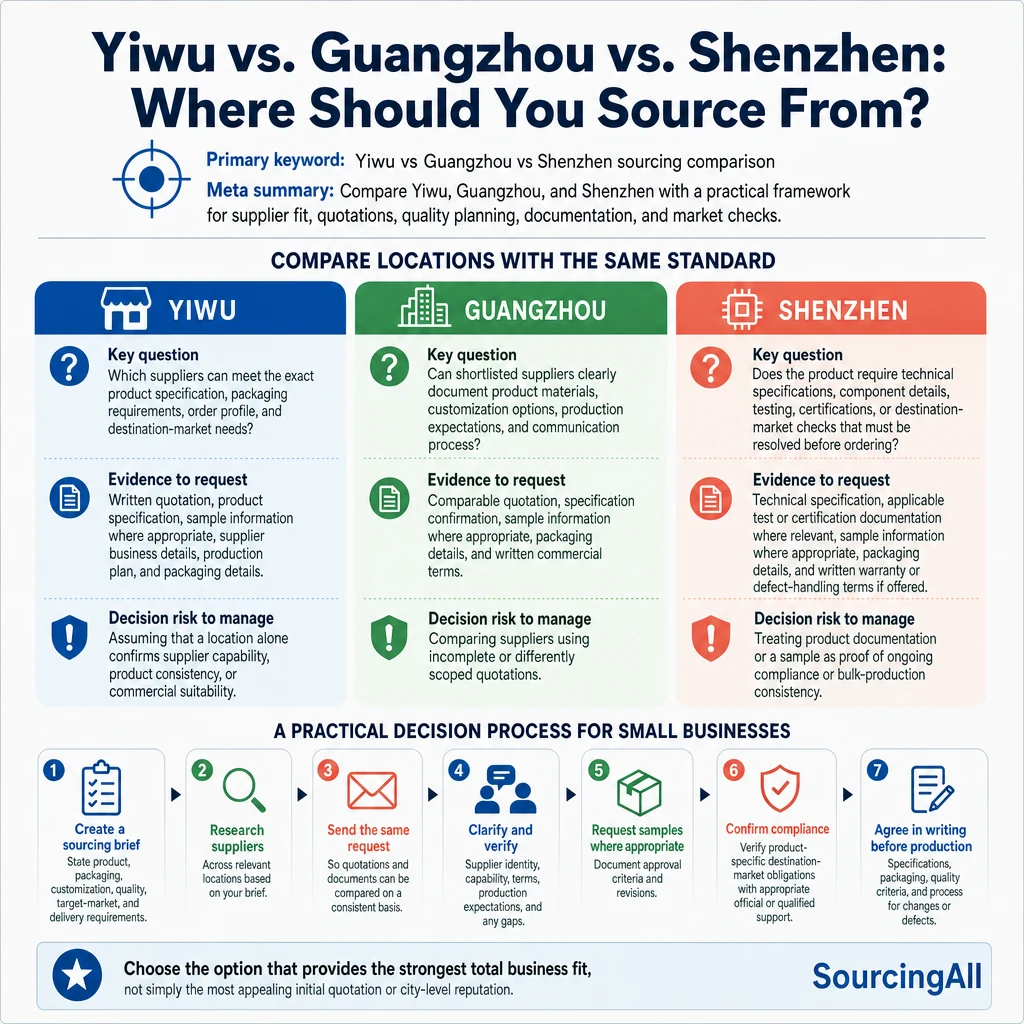
Use each location as an option to evaluate, not as a promise about price, quality, customization, shipping, or supplier capability. A city comparison asks whether the suppliers you identify can provide evidence that matches your brief. These questions apply the same standard of review to each location.
| Location to evaluate | Questions to ask before shortlisting suppliers | Evidence to request | Decision risk to manage |
|---|---|---|---|
| Yiwu | Which suppliers can meet the exact product specification, packaging requirements, order profile, and destination-market needs? | Written quotation, product specification, sample information where appropriate, supplier business details, production plan, and packaging details. | Assuming that a location alone confirms supplier capability, product consistency, or commercial suitability. |
| Guangzhou | Can shortlisted suppliers clearly document product materials, customization options, production expectations, and communication process? | Comparable quotation, specification confirmation, sample information where appropriate, packaging details, and written commercial terms. | Comparing suppliers using incomplete or differently scoped quotations. |
| Shenzhen | Does the product require technical specifications, component details, testing, certifications, or destination-market checks that must be resolved before ordering? | Technical specification, applicable test or certification documentation where relevant, sample information where appropriate, packaging details, and written warranty or defect-handling terms if offered. | Treating product documentation or a sample as proof of ongoing compliance or bulk-production consistency. |
The table is supplier-focused. A buyer researching any of these locations should be able to ask: “Can this counterparty demonstrate that it understands the brief, can scope the work clearly, and will document the agreed requirements?” If the answer is unclear, the city comparison has not yet produced a reliable purchasing choice.
Evaluate supplier fit before comparing unit prices
A low unit price is hard to assess when the scope is unclear. First establish whether each potential supplier is quoting the same product and commercial request. Ask the counterparty to clarify whether it is acting as a manufacturer or trading company, and request business details that support its stated role. Neither label is an automatic sign of suitability; what matters is whether the supplier can explain its part in fulfilling the order.
Then compare the substance of each response. Does the written specification address the materials, construction, finish, functionality, packaging, and customization you requested? Are any changes, exclusions, or assumptions stated plainly? Can the supplier explain its communication process, production expectations, and how it would handle questions about defects or changes? If warranty or defect-handling terms are offered, request them in writing and check whether they are clear enough for your project.
Samples can help you assess whether the proposed item matches your expectations, but an approved sample is not a guarantee that later production will remain consistent. Record exactly what the sample represents, identify any agreed revisions, and keep the approved reference linked to the written specification. The same principle applies to photographs, videos, product documents, audits, or visits: they can inform a decision, but they do not remove the need for a clear production agreement and quality process.
Communication is part of supplier fit too. Notice whether questions receive direct answers, whether documents stay consistent across revisions, and whether the supplier identifies uncertainties instead of overlooking them. A supplier that cannot align on a brief before an order may be harder to manage once specifications, packaging, and delivery arrangements carry more weight.
Compare the total sourcing decision
Unit price should be considered within the full sourcing decision. Request quotations in a format that makes the scope visible: product specifications, packaging, customization, payment terms, production assumptions, delivery terms, and any services included or excluded. If suppliers use different terms, ask for clarification before ranking them.
Buyers should also account for costs and responsibilities beyond the item itself. Depending on the transaction and destination, these can include packaging, inspection, freight, documentation, duties or taxes where applicable, and the commercial impact of resolving defects or mismatched goods. No city-level generalisation answers this calculation. It depends on the particular product, supplier terms, shipping arrangement, and import destination.
To compare offers, create a comparison sheet that preserves each supplier’s original wording while adding your own standard fields. Note what is confirmed, what is assumed, what remains open, and which evidence has been received. This makes it easier to see when one quotation appears attractive only because it leaves out a requirement included elsewhere.
For example, if one supplier’s offer includes the packaging described in your brief while another supplier has not confirmed packaging, those offers are not yet directly comparable. Do not assume either outcome; obtain written clarification using the same packaging requirement.
Plan for quality control and documentation
Quality control begins before production. Agree on the product specification, packaging requirements, accepted variation where relevant, and the criteria you will use to judge whether goods conform to the agreement. Document the requirements in language both parties can use. Phrases like “good quality” are hard to apply consistently unless tied to concrete product and packaging expectations.
Decide in advance how you will review progress and how concerns will be raised. Where an inspection is appropriate, define the inspection scope and the pre-agreed acceptance criteria. Inspection can provide useful information about the goods assessed, but it does not guarantee overall bulk-order quality or compliance. The written requirements remain essential because they define what the inspection evaluates.
Documentation should travel with the sourcing process instead of being assembled at the end. Keep the final specification, quotation, commercial terms, packaging details, sample approvals where applicable, communications about changes, and shipping documents in an organised record. For goods bound for the United States, importers should exercise reasonable care regarding accurate import documentation, packaging, labeling, and origin information, as outlined by U.S. Customs and Border Protection.
For other destinations, requirements differ. Confirm obligations with the relevant destination-country authorities or qualified professionals instead of relying on general sourcing advice or a supplier’s informal assurance.
Check product-specific compliance before ordering
Compliance obligations depend on the product and destination market. Identify them early enough to affect product design, materials, packaging, labeling, testing, documentation, and shipment planning where relevant. Do not assume that a document supplied for one market, product version, or production run automatically applies to yours.
For applicable U.S. consumer products, buyers should confirm whether a General Certificate of Conformity or a Children’s Product Certificate is required. That determination depends on the product and applicable rules. Official guidance, a qualified adviser, broker, testing provider, or relevant authority can help clarify the obligations for a specific transaction.
This is another reason not to select Yiwu, Guangzhou, or Shenzhen based on broad assumptions. Where documentation, technical details, testing, or certifications matter, evaluate whether each shortlisted supplier can provide relevant information for review and whether unresolved questions are addressed before ordering.
A practical decision process for small businesses
A structured process can make the comparison manageable without pretending that one location is right for every buyer.
- Create a sourcing brief that states product, packaging, customization, quality, target-market, and delivery requirements.
- Research potential suppliers across the locations that appear relevant to your brief.
- Send the same request for information so that quotations and documents can be compared on a consistent basis.
- Clarify supplier identity, capability, commercial terms, production expectations, and any gaps in the response.
- Request samples where appropriate and document approval criteria and revisions.
- Confirm product-specific destination-market obligations with appropriate official or qualified support.
- Agree on written specifications, packaging, quality criteria, and the process for handling changes or defects before production.
- Choose the option that provides the strongest total business fit, not simply the most appealing initial quotation or city-level reputation.
The final choice may be Yiwu, Guangzhou, Shenzhen, or a supplier route that emerges from your research. What matters is that the decision is supported by comparable evidence and a workable plan for execution. Due diligence and an understanding of local market conditions are important parts of entering or sourcing in China, as noted in guidance from the International Trade Administration.
Coordinate your sourcing process with clear requirements
If you need help organising supplier research, verification, negotiation support, production monitoring, final inspection coordination, and shipping coordination, review how SourcingAll supports the sourcing process.