
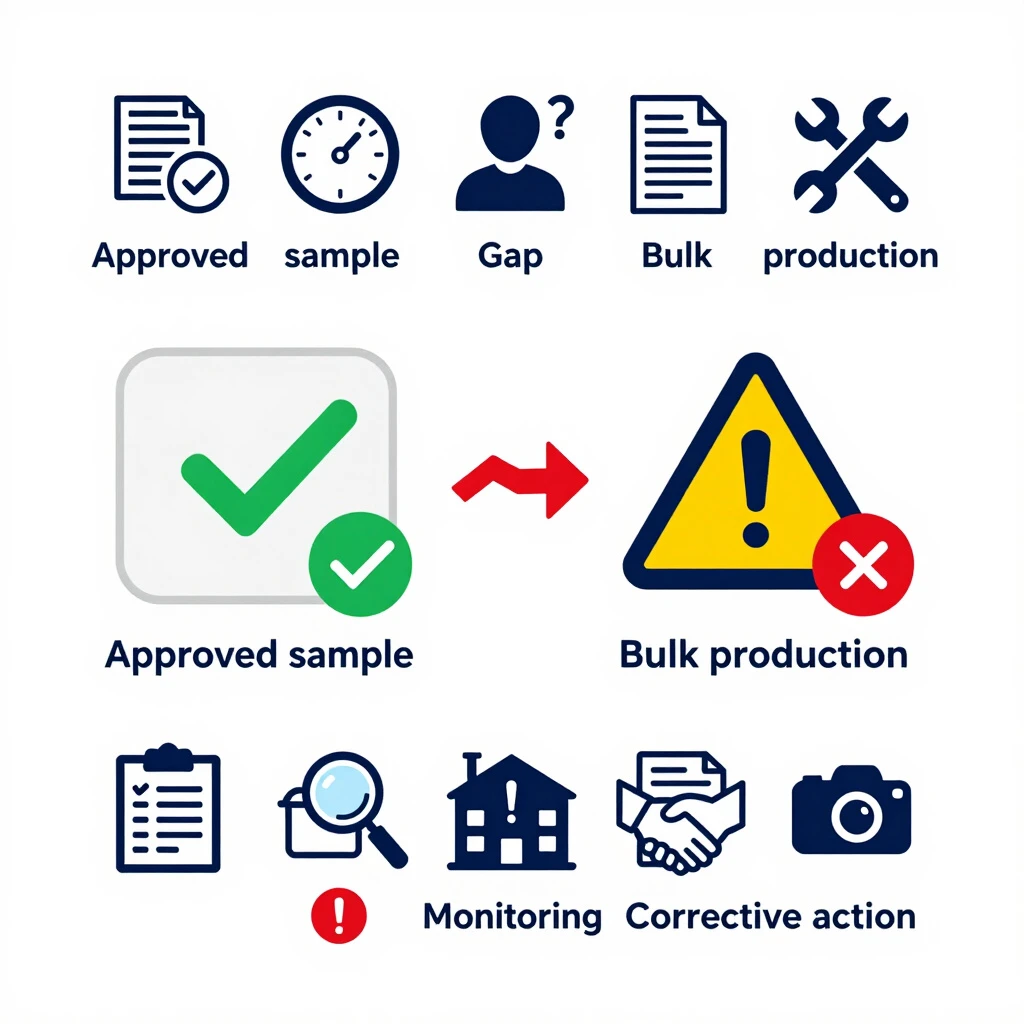
Hypothetical scenario: you approve the sample, the factory sends photos of the production line, and then the container arrives with products that feel lighter, the color is off, or the dimensions don’t fit. The approved sample is a reference point, not a guarantee that every unit will match it. The gap between sample and bulk production comes from identifiable causes. Understanding those causes and putting checks in place before and during production is how you reduce the risk.
Why sample approval matters
Sample approval is the moment you sign off on the look, feel, and function of a product. It sets the baseline for the entire order. But approval only means the factory can make one unit that meets your expectations. It does not mean the factory will automatically replicate that unit across thousands of pieces. The sample is a promise of capability, not a guarantee of consistency. Treat sample approval as the start of quality control, not the end.
If you want to understand how a sourcing partner can structure this process, see How SourcingAll works.
Why bulk production can differ from the approved sample
Several factors can create the gap between a handcrafted sample and mass production.
Material substitutions
Factories sometimes switch to a cheaper or more available material after the sample is approved. The visual difference may be subtle, but the performance can change. Hypothetical example: a plastic that feels sturdy in the sample might be replaced with a recycled grade that is more brittle. The factory may not tell you unless you ask for material certificates or test reports.
Process variations and shortcuts
Mass production uses different tooling, molds, or assembly lines than the sample run. A factory might reduce curing time, lower the temperature, or skip a surface treatment to meet a deadline. These shortcuts may not be visible in photos but can show up in durability or finish.
Human error
Workers on a production line are not the same person who made the sample. They may misread a spec, use the wrong component, or assemble parts in the wrong order. Even with training, mistakes can happen when the line is running fast.
Lack of clear specifications
If your approval is based on a physical sample without written specifications, the factory has no reference for tolerances. A slight dimensional difference in a connector or a color variation may be acceptable to them but not to you. Without numbers, you are relying on the factory’s interpretation.
Tooling and equipment differences
The sample might be made on a prototype machine, while bulk production uses a different press or injection mold. Even a well-maintained mold can produce parts that vary slightly from the prototype. Tooling wear over a long production run can also change dimensions.
These causes are not excuses. They are risks you can manage with the right checks.
How to prevent mismatches before production starts
Prevention is cheaper than correction. Start with these steps before the factory begins the bulk run.
Write down every specification
Create a product specification sheet that includes materials, dimensions, tolerances, color references, weight, and performance requirements. Attach photos and drawings. Send this document to the factory and get written confirmation that they can meet it. Do not rely on the sample alone.
Require a pre-production sample
Ask for a pre-production sample that is made on the actual production line with the same tooling and materials. This sample is more representative of bulk output than the initial prototype. Approve it only after checking it against your spec sheet.
Conduct a factory audit
Before placing a large order, visit the factory or hire a third party to audit its capabilities. Check whether the equipment is suitable for your product, whether they have experience with your material, and whether their quality control system is real. A factory with poor housekeeping may also have weaker quality control.
Put quality standards in the contract
Your contract should state the acceptance criteria, inspection methods, and what happens if the goods do not meet them. Include a clause that allows you to reject goods that deviate beyond an agreed tolerance. This can strengthen your position in discussions if a problem arises.
Monitoring production to catch issues early
Even with good preparation, you need to monitor the production process. Waiting until the goods are packed is too late.
Schedule in-line inspections
Arrange for an inspector to visit the factory at critical stages, such as after the first production batch is produced or when a certain portion of the order is complete. The inspector can check dimensions, materials, and workmanship against your approved sample and spec sheet. Catching a problem early means the factory can rework the affected units before the whole order is finished.
Use production monitoring services
If you cannot be on site, a sourcing agent can monitor production progress and report back. They can check whether the factory is using the correct materials, following the agreed process, and staying on schedule. It is not a full inspection, but it gives you visibility.
Keep communication open
Ask the factory for regular updates, including photos and videos of the production line. If they mention a material shortage or a machine breakdown, ask how they plan to handle it. Some factories flag issues early; others may not.
Set quality checkpoints
Define checkpoints in the production schedule. For example, after the first production batch, midway through production, and before packing. At each checkpoint, compare the output to the approved sample and the spec sheet. This is where a third-party inspection service adds value.
Steps to take when bulk production doesn’t match the sample
If you discover a mismatch, act quickly and methodically. Work through these steps in order.
- Document everything. Take photos and videos of the defective units, measure the deviations, and note the batch numbers. This evidence is essential for any negotiation.
- Contact the supplier immediately. Share your findings and ask for an explanation. Do not accuse; ask for a root-cause analysis.
- Review your contract. Check what the quality clause says about tolerances, rework, and rejection. If you have a clear standard, you have a stronger position.
- Negotiate a remedy. Depending on the severity, you might ask for rework, a replacement batch, or a price reduction. Be realistic. The factory may not agree to a full refund, but they may offer to fix the issue at their cost.
- Get a third-party inspection. If the supplier disputes your claim, hire an independent inspector to assess the entire batch. This gives you an objective report to support your position.
If you have questions about your options, you can visit the Preguntas frecuentes page.
How SourcingAll helps you avoid and resolve production mismatches
SourcingAll offers services that address each stage of the problem. Their sourcing services include supplier search and vetting, sample coordination, product development, production monitoring, quality inspection, and logistics coordination. In practice, that means:
- Investigación de proveedores helps you select a factory that has the equipment and discipline to meet your specs.
- Sample coordination helps ensure that the sample you approve is representative of what the factory can produce in bulk.
- Monitoreo de producción helps you track production progress and identify potential issues.
- Quality inspection at key points can help check the goods against your approved sample and spec sheet before they ship.
- Logistics coordination supports the movement of goods for international buyers.
These services are not a guarantee that every unit will be perfect, but they may help reduce the risk of a costly mismatch. You can explore case studies on our website. To learn more about the team behind the process, visit About SourcingAll.
Take a proactive approach to quality control
Sample approval is a milestone, not a safety net. The gap between sample and bulk production is a normal risk in manufacturing, but it is manageable. Write clear specifications, require pre-production samples, audit your factory, and monitor production at critical points. If a mismatch still occurs, document it, communicate, and negotiate with evidence.
If you want to reduce the risk on your next order, consider working with a sourcing partner who can handle the details. Contact us to discuss your project, or get a quote for our services. You can also browse related articles for more guidance on sourcing from China.